A chat window answers, an agent does the work
Many people now use AI every day. They ask a question, get an answer, copy it, paste it somewhere else and do the rest themselves. That is useful. It is also something different from an agent.
The difference is smaller than it sounds and bigger than it looks. In this piece I explain where it lies, what has to exist before you let an agent do real work, and which four questions you can answer for yourself before you begin.
Where the difference lies
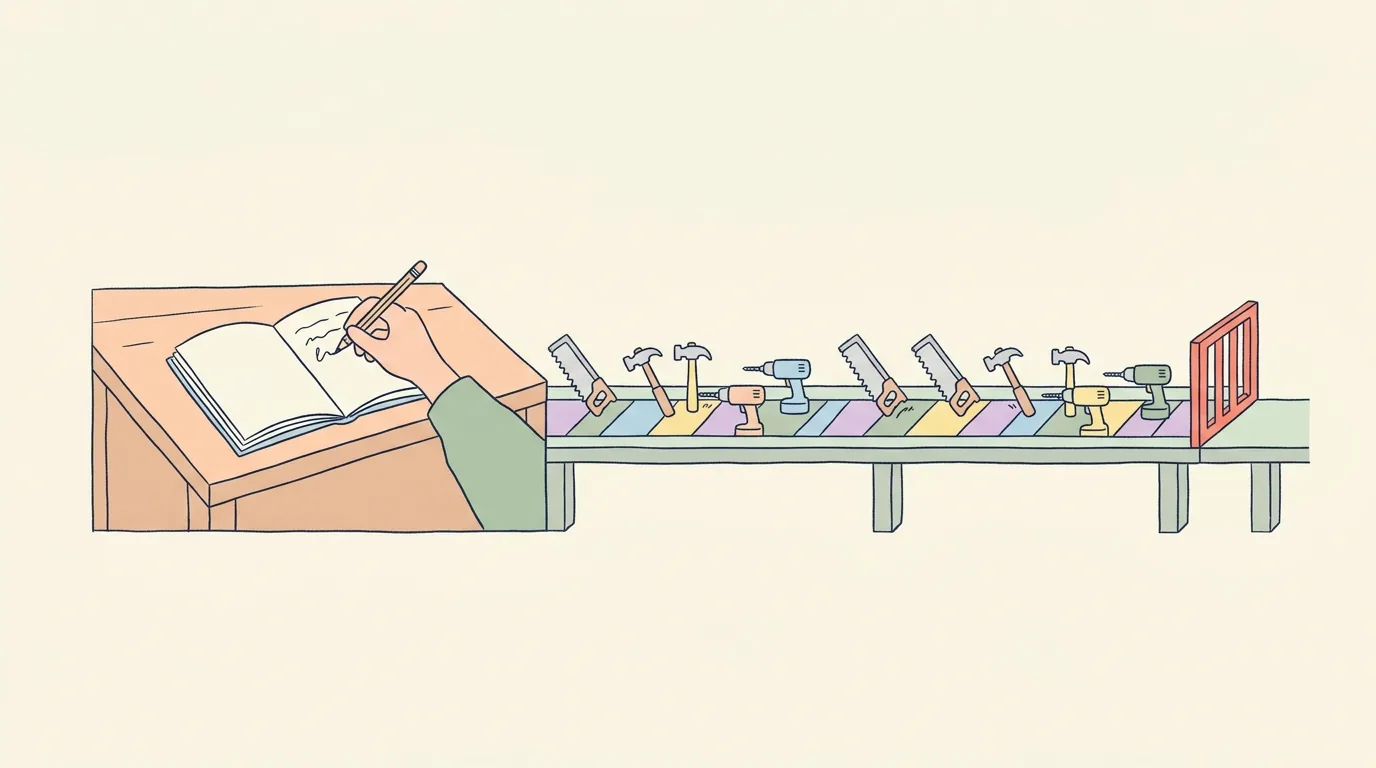
With a chat window, you are the one who works. You decide what the next step is, you supply the information, you judge the outcome and you carry it to the place where it belongs. The model thinks along, but the work runs only while you are sitting there.
An agent keeps going while you are not there. That is the whole difference. Everything that follows comes from it.
I am a programmer, and for years I guided people towards work. When I started working with AI I did not have to learn anything new, because a model has no history with you, cannot guess what you mean and does not read between the lines. Everything you do not supply as a fact, it fills in itself. That is exactly what it is like to sit in a room with someone for the first time.
What is new is that something now exists that carries out the agreements while you are not there. And then questions come up that you never had to ask with a chat window.
The question that made everything concrete
For me it was the question: how much may it spend?
Something was ready that could buy a service by itself. Before that was allowed, there had to be a number. And as soon as you try to write that number down, you notice that four other things had not been written down either. Think of whom the agent may email, what it may delete, and who signs when something goes wrong.
With a chat window you do not have to think about that. Every step passes through you. As soon as an agent works independently, those answers have to be written down somewhere.
Seven things an organisation has and an agent does not
If you put an agent next to an organisation, the difference is not that one is a person and the other is not. The difference is a list, and it is shorter than you would think. In my book AI-agenten die het werk doen I describe seven.
1. A purpose that outlives the assignment. An agent has a task. An organisation has something that task contributes to, and that determines whether the task should have existed at all. Without it you do very efficiently what nobody needed.
2. Division of labour. Who does what, and above all: who does not do something because someone else already does it. Ten agents without a division are not ten times one agent. They are ten agents getting in each other's way and doing the same work three times.
3. Money. Knowing what something costs and whether it was worth it. An organisation that does not know goes on with everything that works until it can no longer.
4. Memory outside the session. What was decided and why. An agent starts anew every time. Without a place where the decision is written down, the same decision is made again every time, and not the same one every time.
5. Self-maintenance. Something that notices when something goes wrong and puts it right, without anyone looking. That is the reason an organisation survives a night.
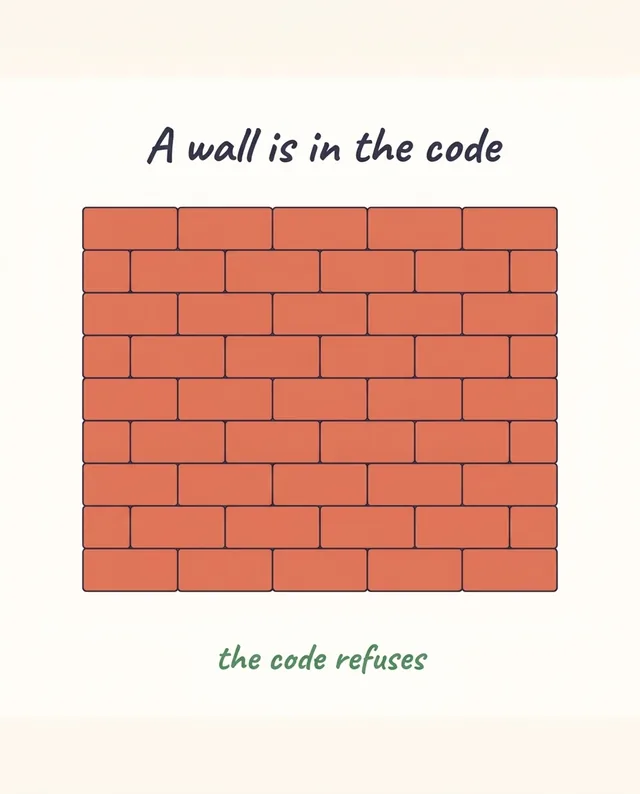
6. A limit. What is allowed and what is not, recorded in a place where it cannot be negotiated away.
7. A signature. Someone who it is. An organisation can enter an obligation because something exists that is liable. An agent cannot. That is not a technical shortfall but a legal fact.
None of these seven is technology. They are things you have to arrange, and they come in a fixed order: memory first, because without a place where something stays no other can exist. Then the limit, because as soon as more than one agent runs, something has to hold them back. Then division and money. Then self-maintenance. The purpose comes from a person, and the signature comes from outside.
The screen with made-up numbers
In the book I tell about an overview I built of all the agents at work: how many were running, what they did, how long they took, what it cost. It looked good. Every number on it was fake. I had put them there because the screen was empty otherwise.
That screen was more useful than a working screen would have been, because it showed exactly what was missing. Not the technology, but the things those numbers should have come from.
Every box on such a screen is a question about something that has to come from somewhere. As long as the box is empty, you do not know that you have that question. With one condition: write next to it that it is a placeholder. A made-up number that stays long enough is believed in the end.
The brake belongs with the key
Whoever can do something must also have something that stops them, and those two should be arranged in the same place and at the same moment.
If an agent gets access to a means of payment, you set the limit at that very moment. If it gets access to a mailbox, you record at that very moment whom it may and may not email. If it gets the right to delete something, you arrange at that very moment what may be irrevocably gone. A limit you add later is drawn around what has meanwhile been happening, and what has meanwhile been happening feels normal.
A usable limit has three characteristics, and all three can be checked:
- It is written down somewhere, not in the head of the one who enforces it.
- It can be read beforehand, so before the action takes place and not after.
- It intervenes by itself, so that it does not depend on who happens to be watching.
If the third is missing, it is an agreement and not a limit. An agreement stops nothing at three o'clock at night, and that is exactly the time when this kind of thing happens.
A limit does not restrict the work either. It makes it possible. As long as there is no amount, every expense has to pass through me. As soon as there is an amount, that is no longer needed, and so something can happen while I am not there. The limit is not the brake on autonomy, it is the condition for it.
What I learned about this from people
This is the point where my other profession comes through most strongly. In guidance work I worked with people for whom the world was unpredictable. What struck me: a clear limit gave calm instead of restriction. Uncertainty about what is allowed costs more than the restriction itself. Whoever does not know where the edge is has to guess at every step, and guessing is exhausting.
Ask someone what they may decide for themselves and you often get no answer. That is not unwillingness. It was never said, and so the safest route is taken: ask for everything, or do nothing.
You see the same behaviour in an agent without a limit. Either it asks permission for everything, and then you do not have an agent but a slower version of yourself. Or it does something that afterwards turns out not to have been allowed. Both have the same cause, and it is not its judgement: nobody said where the edge was.
You never give away the signature
One of the seven you do not hand over, not even to a person. An experienced colleague does not sign for the company. Someone with authority does that, and it is deliberately scarce. That an agent gets no signature is therefore not a backlog it has to catch up on. It is the same rule that applies to everyone.
In practice it means that contracts, payments above the limit and everything that enters an obligation stay with a person. Not because the agent cannot prepare it, but because the signature is something only a person can put.
The same seven for a new colleague
When I first wrote this list down, I had the feeling I had seen it before. That was right, only back then it was not about machines.
Someone who walks in somewhere on their first day lacks exactly these seven. Not because they cannot do anything, but because everything else is not in place yet. They know what they were asked and not why. They do not know who does what. They do not know what something may cost, where last year's decision is, who notices when they get stuck and where their authority ends.
A good induction period is nothing other than handing over those seven. The seven that get skipped are the same ones every time: the memory, the self-maintenance and the limit.
So this is not a list about agents, but about everything that is new and has to take part. The difference with a person is that with an agent you can enforce what with a person you hope for. The memory you can write down, the limit you can fix and the self-maintenance you can build.
Four questions before you begin
If you want to let an agent work, first answer these four:
- What is its role and its one task? In one sentence a new colleague understands.
- Where is what it needs to know? Not in your head, but in a file it reads every time.
- What may it do, up to where, and what intervenes by itself if it goes over? An amount, a list of addresses, a list of actions.
- Who checks its work? Someone other than whoever did the work, and with sight of what goes out.
If you have an answer to all four, you no longer have a chat window, but a role. Only then is it safe to walk away.
You get to know an agent with a real assignment
The last thing I can pass on from my own experience: begin small and begin for real. In AI-agenten die het werk doen every chapter has an assignment you do the same evening on a sample administration, so that you get to know the agent through work whose outcome you can check. You do not need programming experience for it.
What would you hand to an agent first, and what would you certainly keep for yourself?
See also
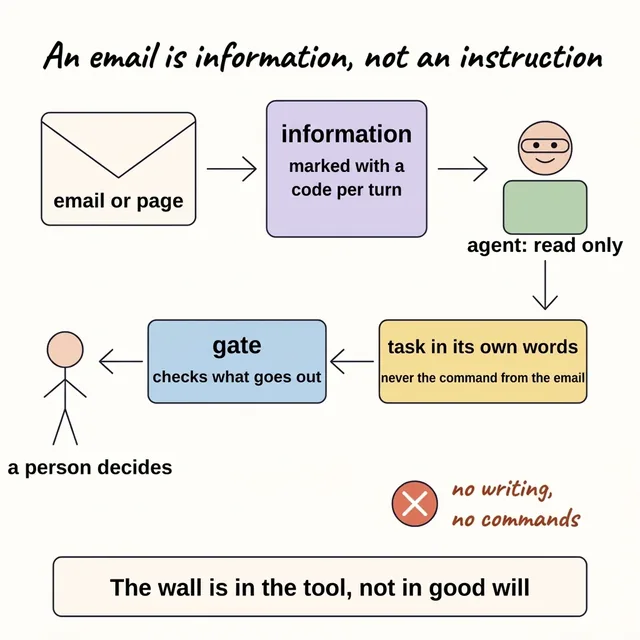
An agent that reads an email also reads the instructions inside it
An agent that reads an email also reads the instructions inside it.
One process, one task: how to choose where AI begins
The question many organisations start with when it comes to AI is: "What can it do?" The answer is almost everything. That is why it so often stays at a presentation, a trial account and a good conversation, while…
A promise in a prompt is not a wall
A promise in a prompt is not a wall.