How much trust do you give an AI agent on day one?
How much trust do you give an AI agent on day one?
With me: almost none. And that works better than I expected.
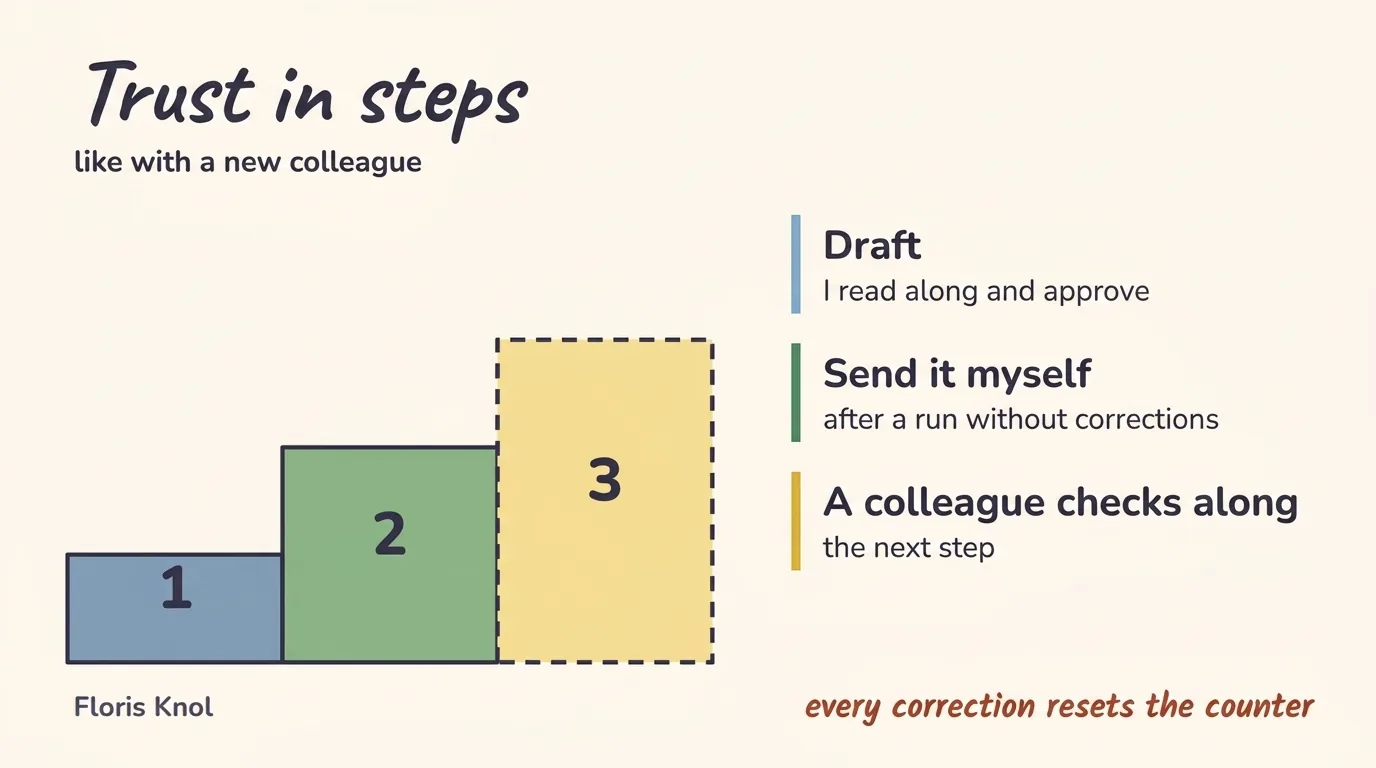
A few AI agents now do real work for me: answering email, preparing appointments, drafting texts. What makes the difference is that they earn trust in steps, like a new colleague:
- Everything that goes out starts as a draft. I read it and approve it.
- After a run of items I approved without corrections, an agent may send ordinary replies on its own.
- The next step: a colleague checks the work instead of me.
Every correction resets the counter.
What surprised me: it was not only the agent that got better. I got better at explaining what I want. Every correction became a rule the agent knows from then on.
How do you handle it? Do you hand an AI tool the keys right away, or do you let it walk along for a while first?
See also
A chat window answers, an agent does the work
Many people now use AI every day. They ask a question, get an answer, copy it, paste it somewhere else and do the rest themselves. That is useful. It is also something different from an agent.
An agent that reads an email also reads the instructions inside it
An agent that reads an email also reads the instructions inside it.
One process, one task: how to choose where AI begins
The question many organisations start with when it comes to AI is: "What can it do?" The answer is almost everything. That is why it so often stays at a presentation, a trial account and a good conversation, while…