An agent orders a server. What I let it do, and what I didn't

Little by little I give my agents more room. The first real step was a server. Dex, my Operations agent, ordered one, installed NonStopWorker on it himself and showed that it ran. From order to login took under two minutes. The server costs five euros a month. The AI cost of the tickets was zero euros, and Dex himself cost less than a euro.
The good news is not the speed. It is how I set the limits.
First the ceiling, then the order
An agent that may buy something needs a limit before it starts. Dex orders from TransIP through their API, and his ceiling is fixed: an amount per order and an amount per month. If a purchase would go over it, there is no discussion: the order does not go through.
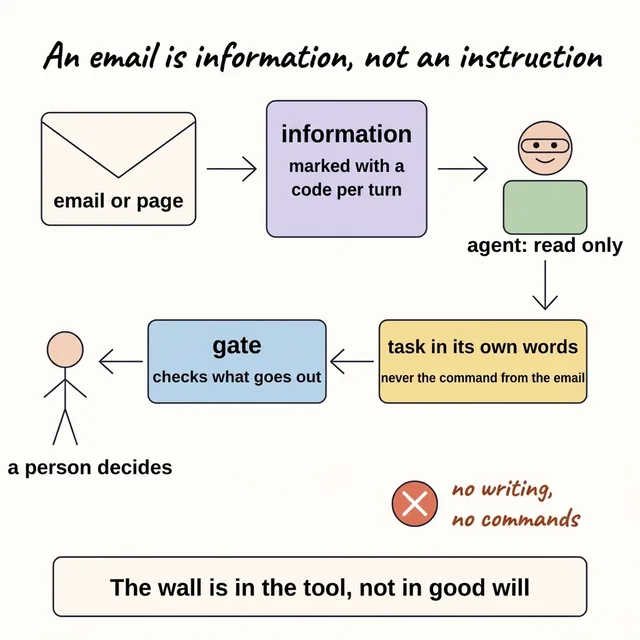
The ceiling is not in a prompt. It is in the tool he orders with. An agent can misread a wish in a prompt. A limit in the tool is one he cannot move.
A human says yes to the purchase
Within the ceiling, Dex does not order on his own. He presents the order: what, from whom, what it costs. Only after my yes does it go through. I do not need to think about how the API works. I judge an order.
The keys never show up
The keys for the API sit in a file the agent uses but never displays. They are not in a ticket, a log or a message. So nothing Dex writes can contain a key, not even by accident.
A check on every ticket
Every ticket in this setup has a check that proves something. "The server runs" is a claim. "You can log in and NonStopWorker answers" is proof. More on that in part 4 of this series.
What you can take from this
If you want an agent to buy something, start so small that a mistake costs nothing:
- Pick one kind of purchase, for example a small server.
- Put the ceiling in the tool, not in the instruction.
- Let a human say yes to every order.
- Keep keys out of everything the agent can write.
- Write down the check before you begin.
I show this in a video of just over six minutes, in English. The link is below.
Which small purchase in your organisation would you dare to give an agent tomorrow, with a ceiling attached? I am happy to look at that with you for a day, in an Expert Day.
See also
A chat window answers, an agent does the work
Many people now use AI every day. They ask a question, get an answer, copy it, paste it somewhere else and do the rest themselves. That is useful. It is also something different from an agent.
An agent that reads an email also reads the instructions inside it
An agent that reads an email also reads the instructions inside it.
One process, one task: how to choose where AI begins
The question many organisations start with when it comes to AI is: "What can it do?" The answer is almost everything. That is why it so often stays at a presentation, a trial account and a good conversation, while…