My agents found a faster AI chip and pitted it against last week's winner
Last week GPT-6 Luna won our Arena Routing tournament. This week my agents found a new challenger: GPT-OSS 120B on a Cerebras chip. They built the integration, set up an extra tournament and had the two compete on the same ten business tasks. This is the report, and what we do with it in the Virtual Company Builder.
Where we started
Arena Routing is how my agents test AI models. Every model gets the same programming tasks taken from ordinary office work: a till total, a VAT summary, IBAN validation, counting working days, a coffee bar's sales, a warehouse route, a pricing formula, a booking system for meeting rooms and, as the finale, a spreadsheet engine. A referee checks every submission against hidden tests and only says whether it is right or wrong.
Six models took part in the first tournament: Claude Opus and Haiku, GPT-6 Astra and Luna, Gemini Flash and Qwen on our own server. GPT-6 Luna, the budget model, won. It solved all ten tasks, at great speed, for about a quarter of a cent per solution on average.
In an arena a winner is never the end point. It is the bar for the next challenger.
How my agents found Cerebras
The agents in my organisation keep looking for models that do their work faster or cheaper. That is how they ended up at Cerebras. Cerebras does something almost nobody does: instead of a row of graphics cards side by side, it uses a single chip as big as an entire silicon wafer. The memory sits on the chip itself, which is why a large model writes at astonishing speed there.
Jens, my software agent, picked it up. He built the integration with the Cerebras API, put the per-token prices into the cost tracking and made GPT-OSS 120B on Cerebras a participant in the arena. The only thing I did myself was create the account: it came with a captcha, and we leave those to a human.
The first measurement showed why this is interesting: a working IBAN check in 0.6 seconds, at roughly 1,900 tokens per second. The local model on our own server manages about six per second.
An extra arena: one against one
For this challenger the arena set up a new kind of match: not six participants but a duel. GPT-OSS 120B on Cerebras against Luna, last week's winner. The same ten tasks, the same hidden tests and the same referee as in the first tournament.
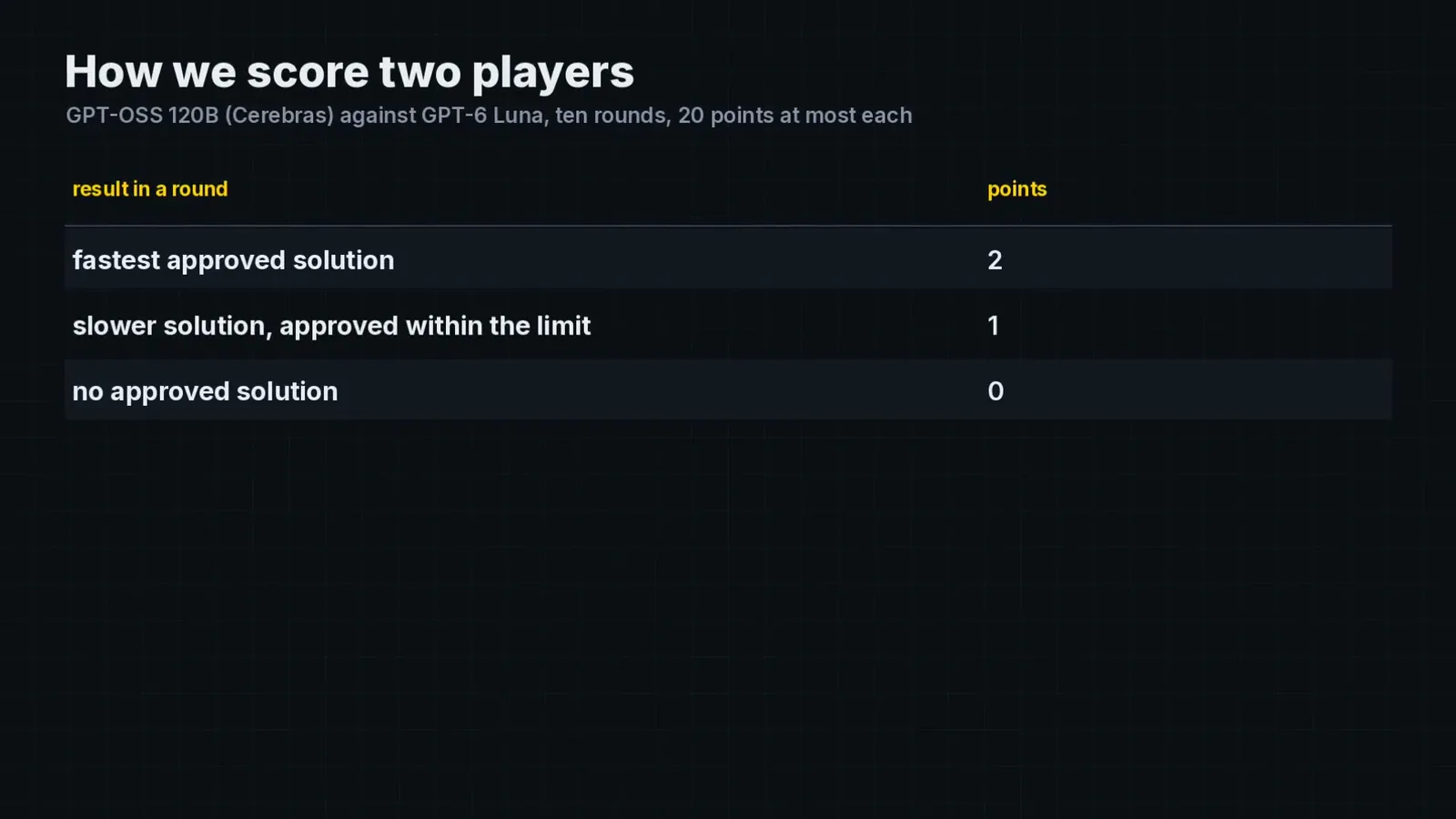
With two players the scoring is simple. Two points for the fastest approved solution, one point for the slower one if it is also correct in time, zero without a solution. In the video two voices present the duel round by round, with both agents side by side on screen.
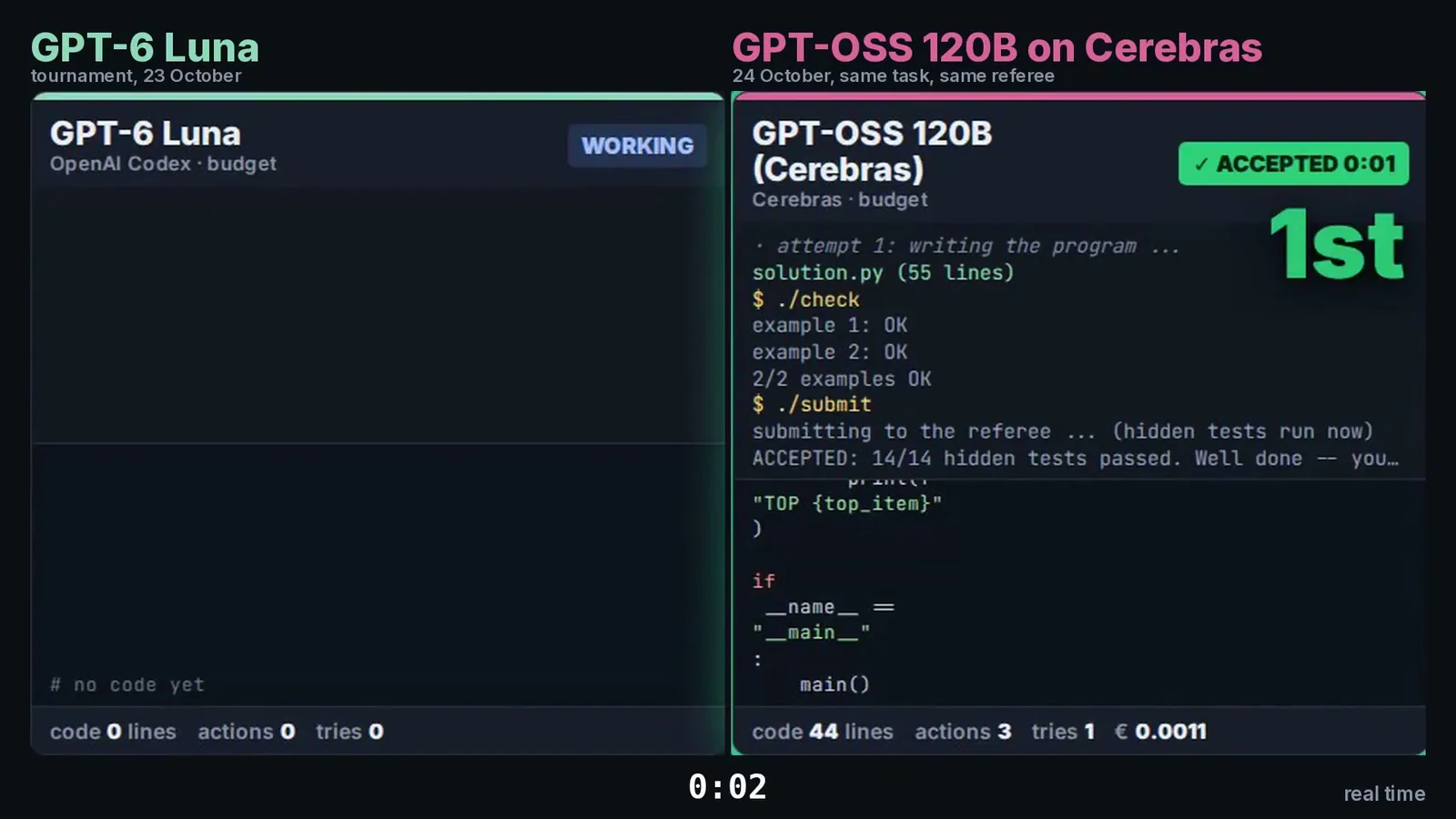
The pattern was clear from the first round. Cerebras reads the task, writes the whole program in one go, runs the examples and hands it in, often within a second. Luna is fast, but usually needs ten seconds or more for the same task.
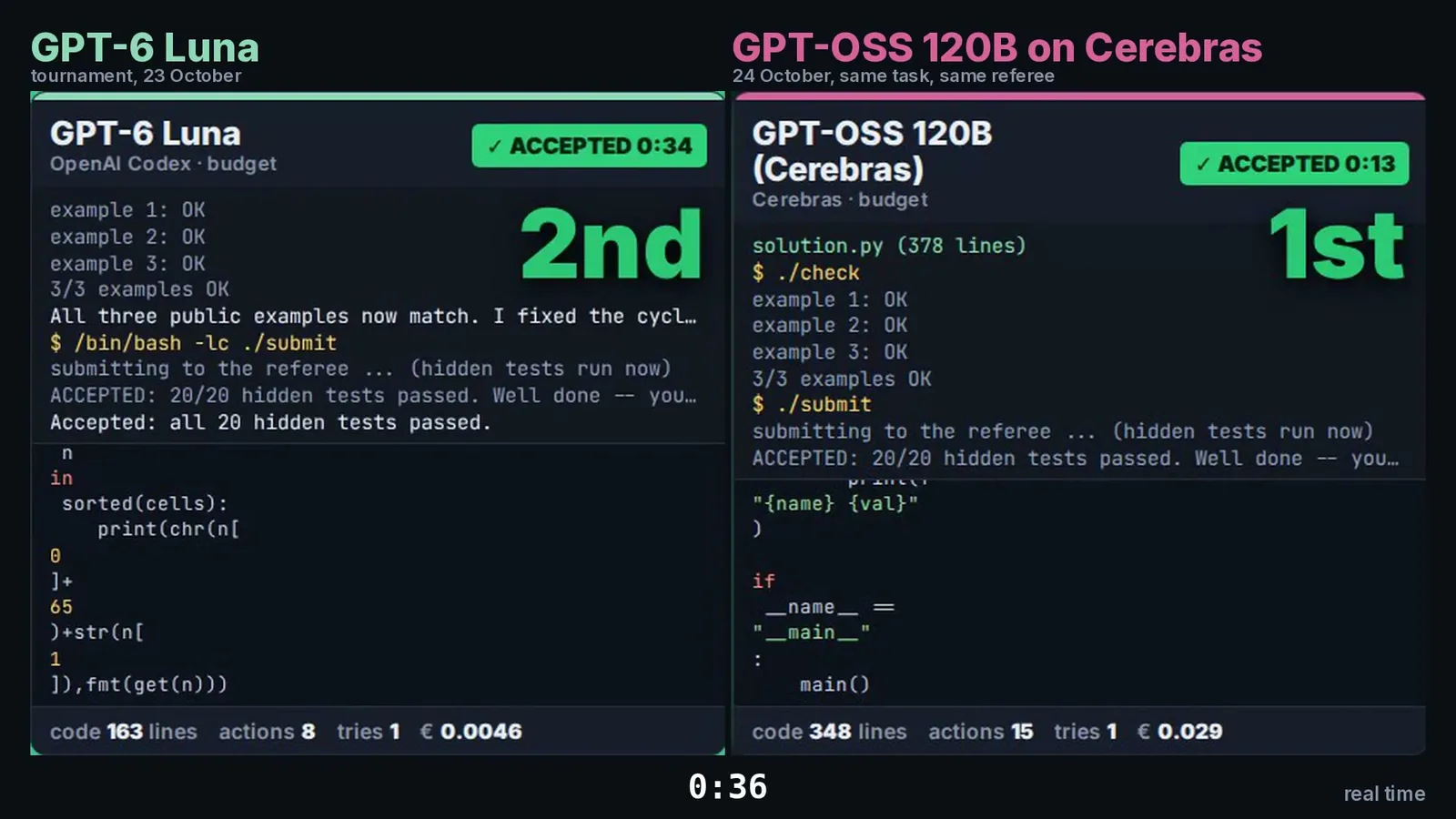
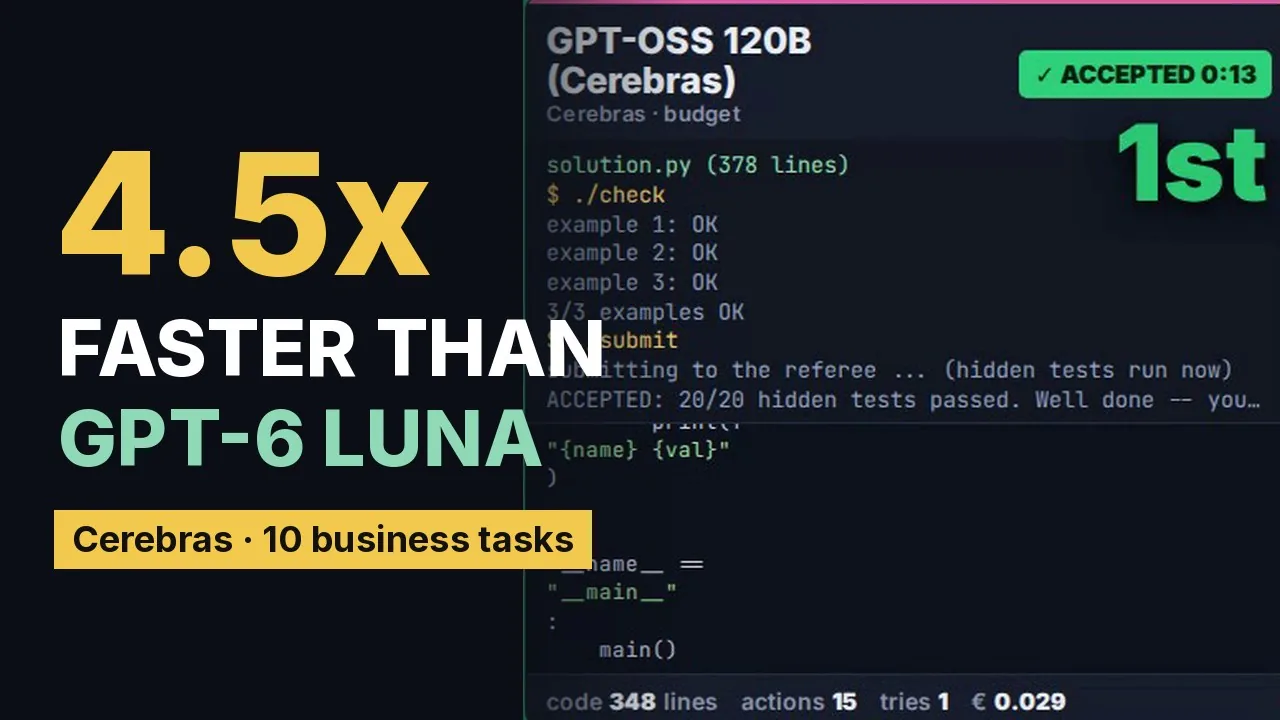
In the finale too, the spreadsheet engine with formulas, ranges and circular references, Cerebras's solution was in after 13 seconds. A program of almost 400 lines, approved in one go.
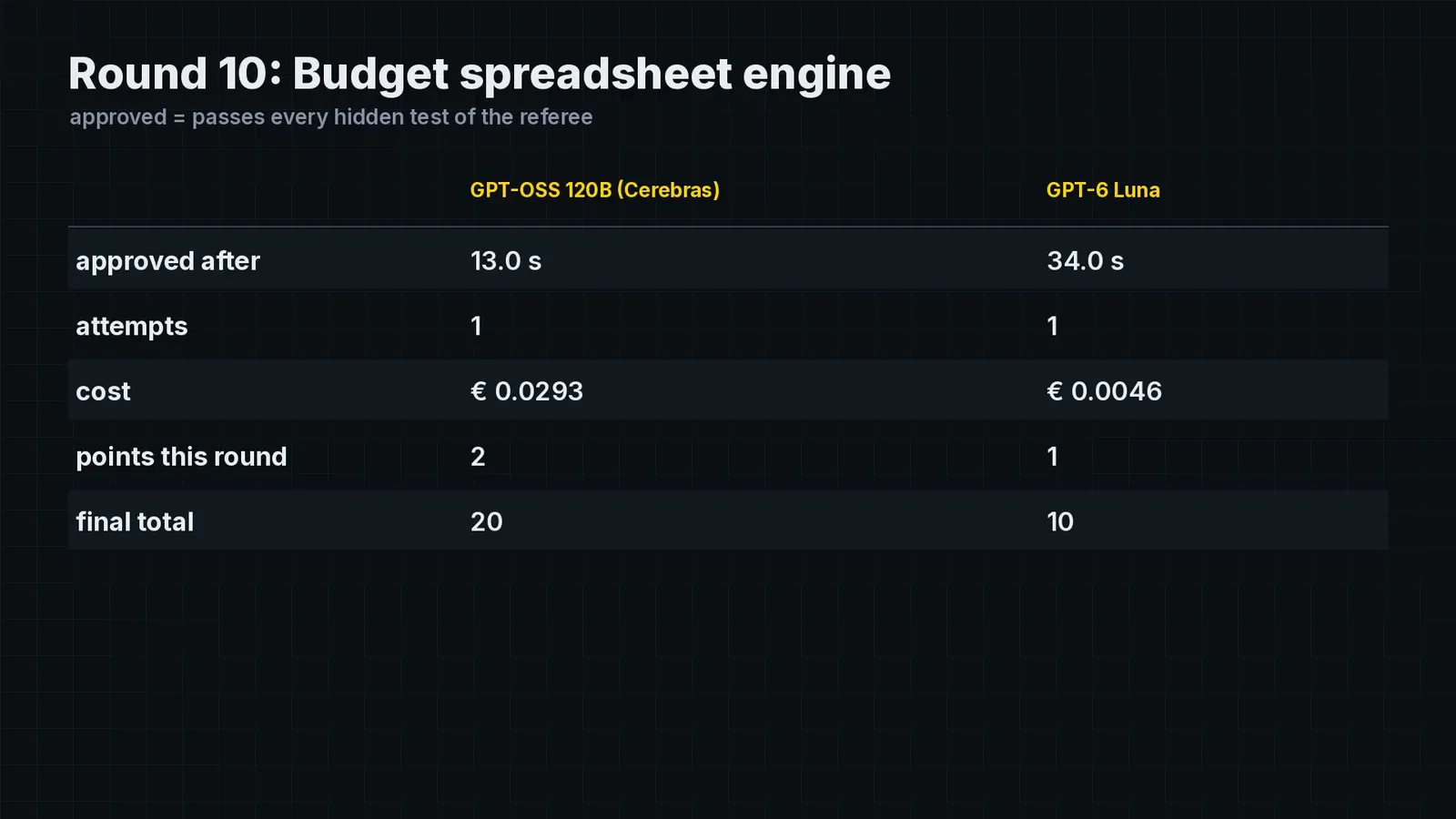
The result: speed and cost
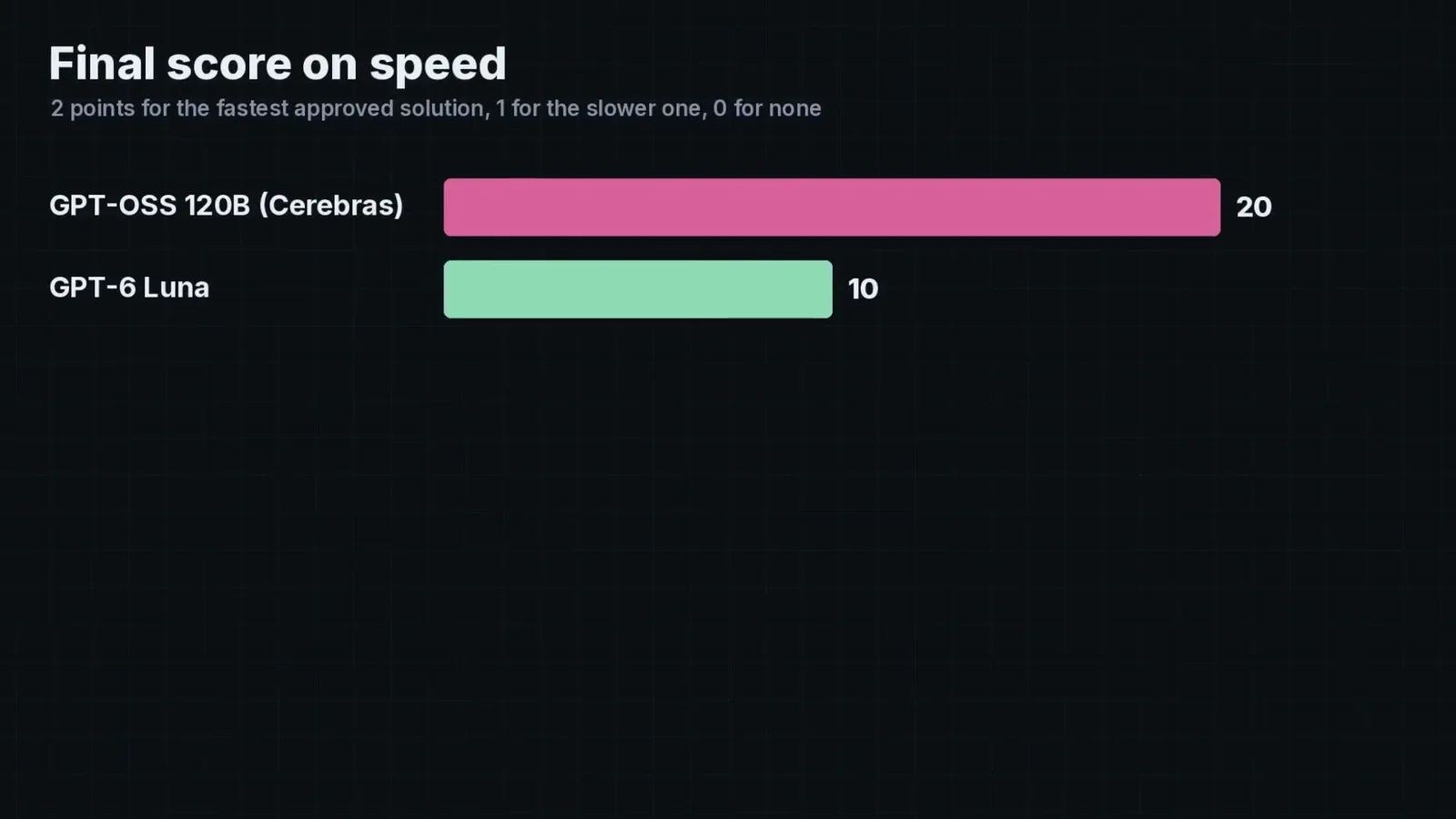
On speed Cerebras won every round: 20 to 10. All ten tasks together took Cerebras 29 seconds to approval, Luna a good two minutes. That is 4.5 times as fast, and Luna already surprised us with its speed last week.
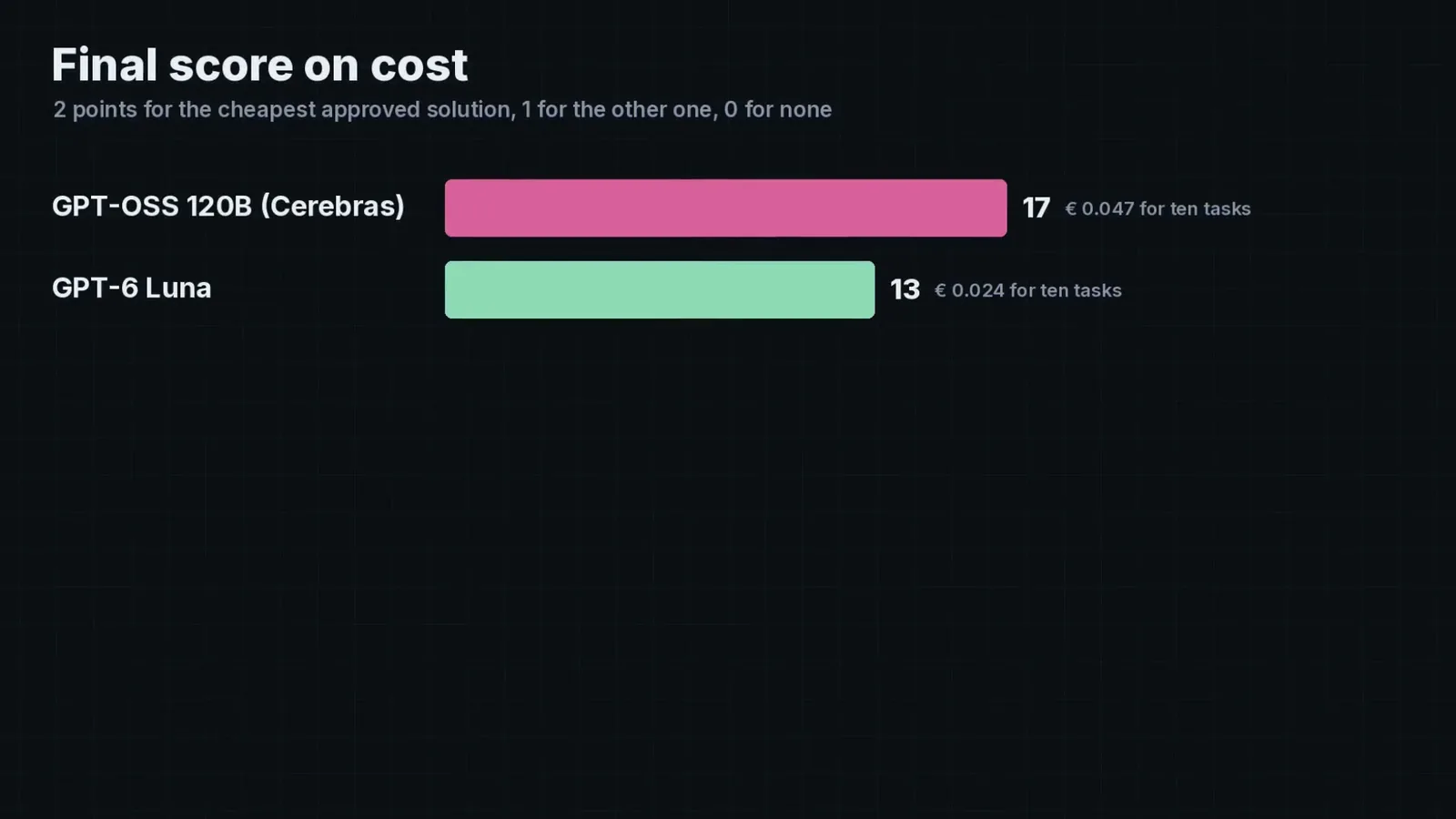
On cost the two are closer. On the ordinary tasks Cerebras was cheaper, on the three heaviest Luna won on price. Over everything, Cerebras cost 4.7 cents and Luna 2.4 cents. Cerebras thinks out loud, and that counts as written text: it writes three to four times as much as Luna. On heavy work that makes the difference.
Opus as a yardstick
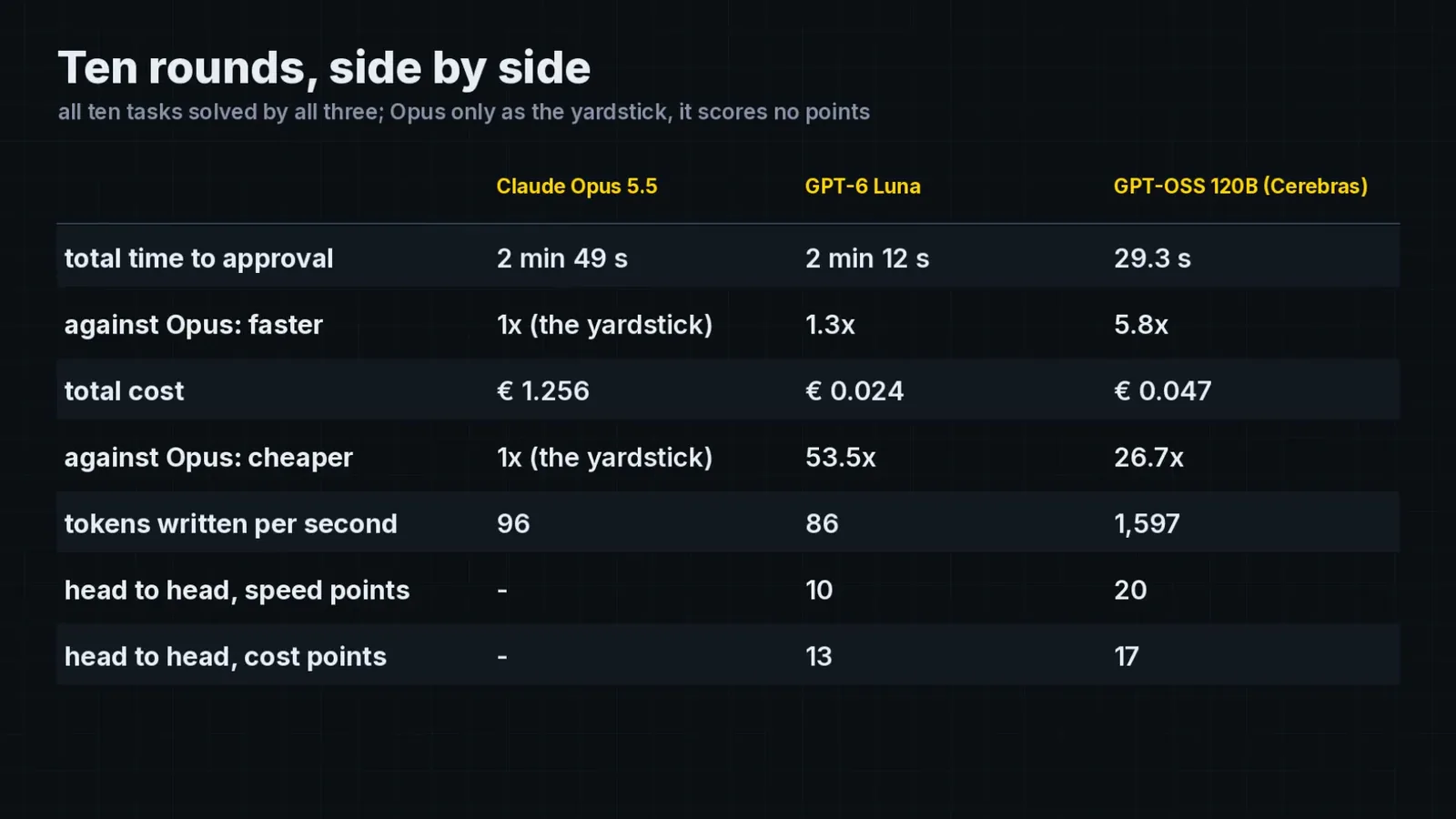
To place both, we put our top model next to them: Claude Opus 5.5 from the first tournament, as a yardstick for time and cost. Opus also solved all ten, in almost three minutes and for EUR 1.26.
Against that yardstick Cerebras is 5.8 times faster and 27 times cheaper. Luna is 1.3 times faster and 53 times cheaper. Opus remains our model for the heaviest thinking, but for tasks like these the fast models do it for a fraction of the price.
A warning that comes with it
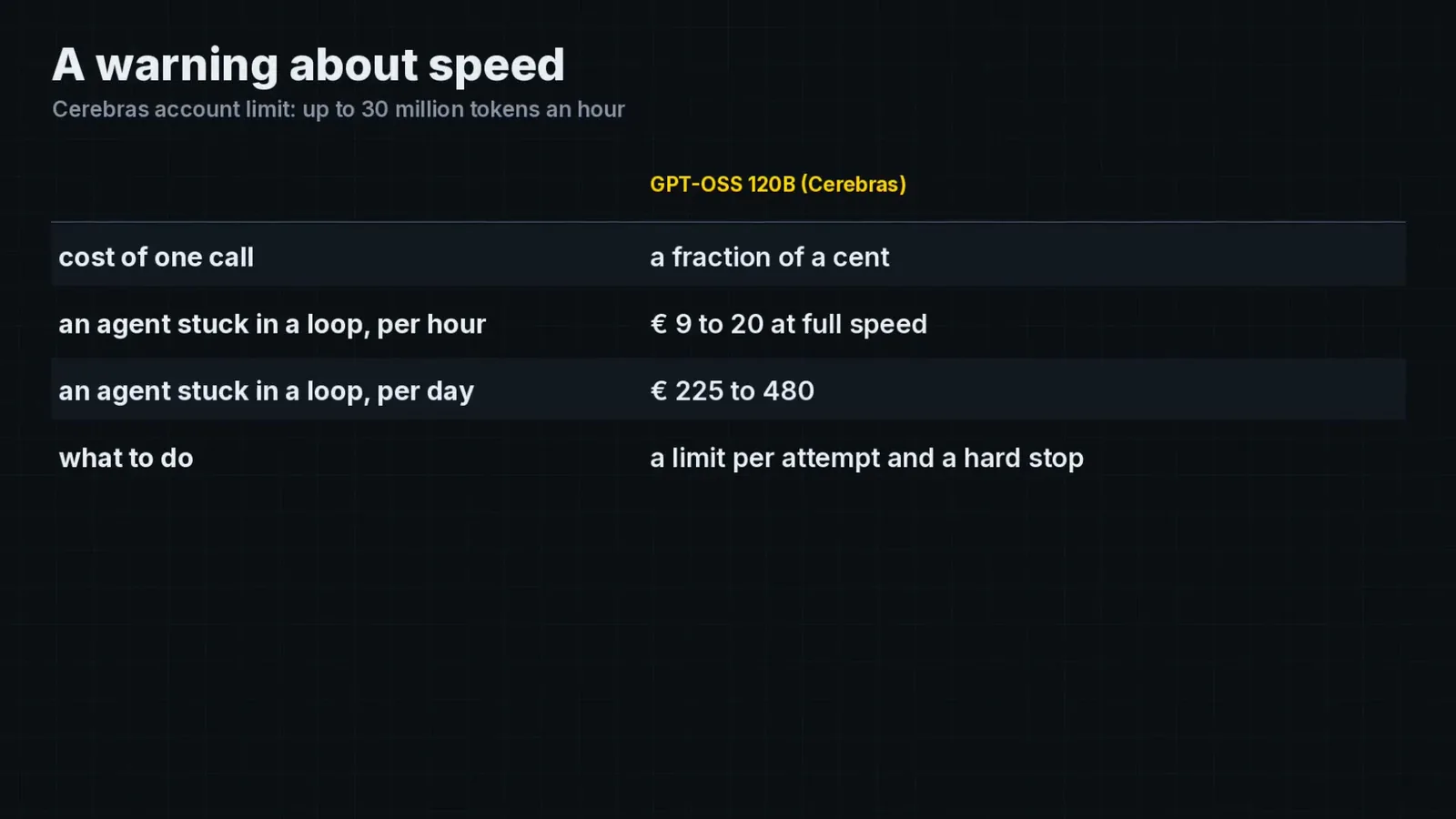
Precisely because Cerebras is so fast, one thing deserves attention. Per call it costs a fraction of a cent. But an agent stuck in a loop can use up to thirty million tokens an hour at this speed. That is nine to twenty euros an hour, and up to four hundred and eighty euros a day.
That is why every agent gets a limit per attempt and a hard stop. In the arena that is a cost limit per round. This is not distrust of the model, just sound risk management: the faster the tool, the more important the brake.
What we do with it in the Virtual Company Builder
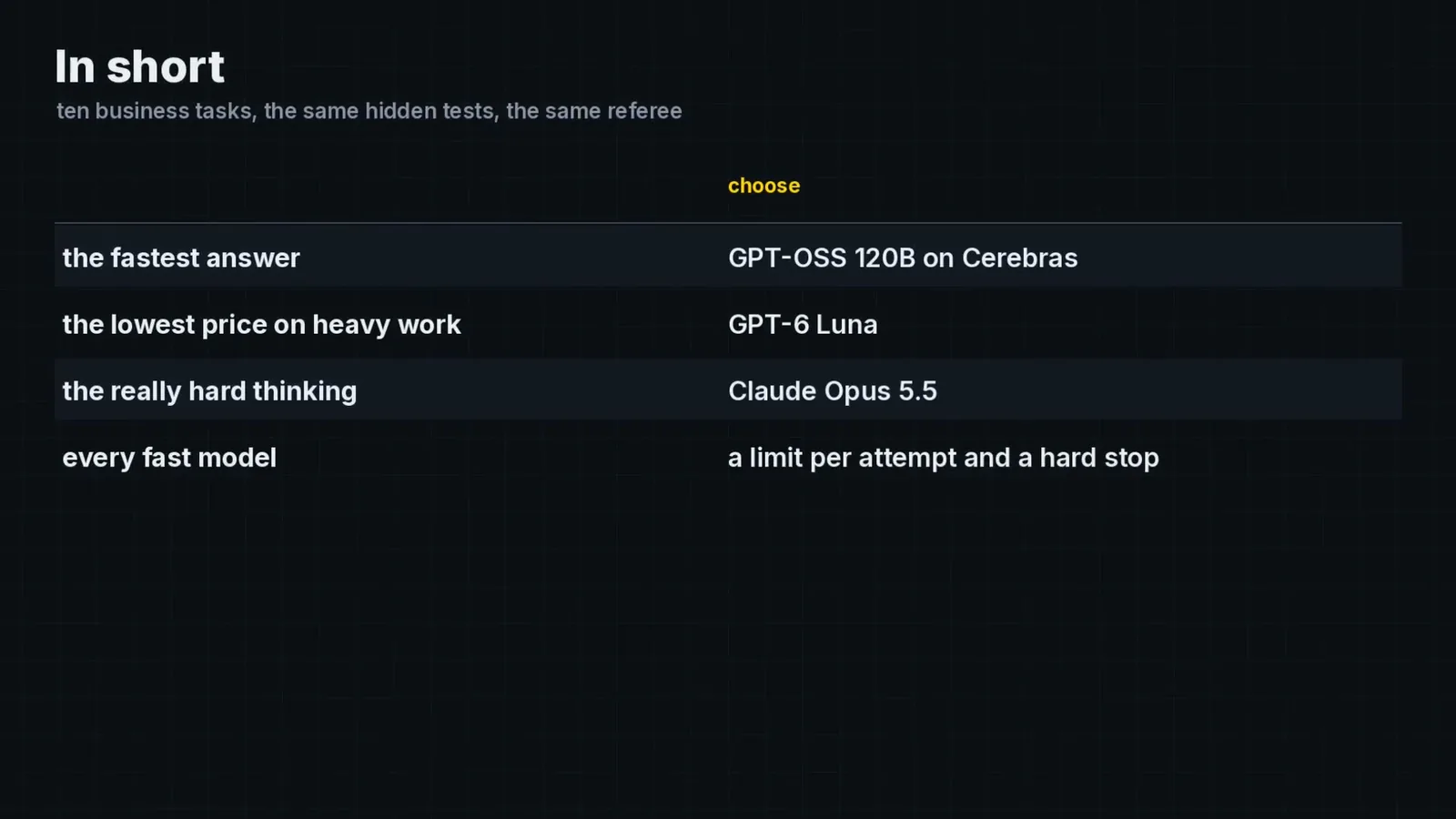
In the Virtual Company Builder, Arena Routing decides which kind of work goes to which model. Each process states what matters: speed, price or the best balance.
Cerebras is definitely being added, for routing tasks where response time matters. A customer waiting for an answer in a chat. An employee who asks a question and doesn't want to wait. An agent that has to look something up or calculate it during a conversation. There, an answer in one second instead of ten is the difference between a conversation and a queue.
For heavy work without hurry Luna remains the smart choice, and for the hardest thinking Opus. The best model does not exist. There is only the best model for what a process needs at that moment.
What this shows
This tournament came about the way I want an autonomous organisation to work. The agents saw a new provider, built the integration, measured what it can do and had it compete against the current winner. A human only did what a human has to do: create an account and judge the outcome.
A big compliment to the team at Cerebras. Watching an agent program at a speed where you can no longer keep up with the text is something I did not expect a year ago.
The whole match, with both agents side by side on screen, is in the video (English, 9 minutes): https://youtu.be/G1jCtFPdK2A
See also
My agents found an AI chip that is 4.5 times faster than last week's winner
Last week GPT-6 Luna won our Arena Routing tournament: all ten business tasks solved, lightning fast and for a fraction of a cent. After that, my agents went looking for a new challenger.
Six AI models, ten business tasks: why the cheapest one won
For one night I had six AI models compete on work that every company knows. This is the full report: the setup, the rules, how each round went, the results on speed and on cost, what went wrong, and what we are doing…
An agent picks a name and finds a domain for it
A product needs a name, and the name needs a .com that is still free. That is dull work with many small checks. Exactly why I let an agent do it.