More than an AI book: a blueprint for autonomous organisations

The Autonomous AI Company is almost finished. It runs past 3,000 pages, and the whole book is coming to YouTube, one episode a day.
Most writing about AI agents stops at the moment things get interesting. One agent, one task, a good result. Then you add a second agent to check the first, a third to collect information, a fourth to keep track of what changed. One morning you are not looking at an agent any more, but at a group that is busy all at once. Two of them do the same work. One works with old information. One approves what another just rejected. The costs keep running, and nobody can say which task caused them.
The agents did not get worse. The organisation is missing.
That is where my new book begins. The Autonomous AI Company (Building a beauty empire with AI agents) picks up where From Zero to AI Agents That Do The Work ended, and it is almost finished. It has grown past 3,000 pages. Starting today, the whole book appears as a video series on YouTube, free for everyone, with a new episode every day.
One salon, and everything around it
The book follows one company from the first day. Sawasara is a Thai massage salon in Bangkok that grows into a worldwide beauty company. People give the treatments: the massage, the care, the attention a customer comes for. AI agents run the business around them. Planning, stock, suppliers, payments, marketing, customer relations, bookkeeping and, later, opening new locations.
Sawasara does not exist. That is on purpose. A company that does not exist lets the pattern behind it show, and that pattern applies to any organisation that hands work to agents, in any sector. A salon happens to be a good place to see it, because the work is physical and personal, and everything around it can be organised.
A role is a contract, not a personality
The first thing the book does is take the word "agent" apart. In Sawasara, nobody is just "the agent". There are roles, and a role is a contract: what it does, what information it needs, what it may change, what it may cost, how its result is checked and when it has to stop. The agent working in a role can be replaced later. The contract stays.
Every result has one owner. And the check on a result never sits with the role that produced it. When a temporary team opens a new location, the controller stands outside that team, so the check does not simply confirm what the team already believes. When something goes wrong, you want to see where it went wrong: was the goal wrong, the execution, the check, or was the event never recorded? If everything is called "the agent", you cannot tell.
Limits that live outside the model
A rule in a prompt is a wish. The book puts limits where an agent cannot talk its way around them: in the permissions a role has, in the budget attached to a task, and in the tool that refuses when a limit is reached.
Take a Thursday afternoon in the book. The payment role prepares the weekly batch and finds three invoices from the same supplier of massage oil. Each one sits just below the amount above which a person has to approve. Together they are well above it. A rule that looks at one invoice at a time lets all three through. The payment role looks per supplier and per day, sees one expense in three parts, and puts them on hold as one batch with a single question to the salon manager. No fraud, no mistake, no damage. But the scene shows the point of the whole chapter on money: a limit only holds when it checks the unit in which money actually moves.
The agents themselves cost money too. Every call to a model has a price, and an agent stuck in a loop can spend more in one night than a salon spends on stock in a week. So in Sawasara the agents' own usage gets the same structure as every other expense: a goal, an owner, a limit, proof and a check.
Memory with a source and a date
An agent remembers what is in its context. An organisation remembers what it writes down, with a source and a period of validity.
In the book, the planning role draws up a weekend roster. A therapist is listed as qualified for a certain treatment, but the record has passed its review date, so it no longer counts as proof. The planning role does not schedule her for that treatment, says why in the roster, and asks the staff role to confirm the qualification again. It turns out the licence had already been renewed; the new proof had simply never reached the register. Now it has, with its source, and the old record points to the new one.
Nothing dramatic happened. That is the design working. Memory without a source and a date is how an organisation of agents ends up acting on something that stopped being true.
The person at the edge of the system
At the start, a person stands in the middle of everything. They see customers come in, sort out the roster, check the stock and sign the bills. That works for one salon on its first day. It does not grow.
So the book moves the person step by step to the edge of the system. Not because human work matters less, but because at the edge you see patterns, risks and direction instead of every small problem. At the edge, a person decides what the organisation pursues, which values are not negotiable, how much room it gets, when a new phase may begin and when everything stops.
There is a scene that shows what that means. On a Thursday evening an invoice arrives from the landlord of the second salon. It is above what the finance role may pay on its own, and it is due on Friday. The role sends the founder one question: the amount, the reason, its advice to pay, and what it will do if nobody answers, which is not to pay and to keep an eye on the deadline. The founder is on a plane. The question goes to a second authorised person, who is asleep in another time zone and answers in the morning. The payment is made twelve hours later than technically possible, and the register says why. Nothing irreversible happened in between.
The person at the edge is not a link the work has to pass through. They are an authority that has to be reachable, with a second route when they are not, and a safe outcome when nobody answers.
From one salon to many
The book is patient about growth. Sawasara starts small on purpose: one salon, a few therapists, an agenda that needs filling. A second salon opens only when the first no longer depends on its founder, because otherwise you double the founder's work instead of sharing it. The organisation grows from about ten roles to a hundred, and later towards a thousand, and each step has to prove itself before the next one starts. Adding capacity that solves nothing only multiplies the mistakes and the costs.
Further on come the things a growing company runs into: new markets and their customs, time zones, regulation, takeovers, an academy, new trades next to massage, and what to do when an agent escapes its role or someone tries to manipulate the system from outside.
Why this is more than an AI book
You can read the book as a story about a salon. You can also read it as a working design. Every chapter ends in things you can use: role cards, registers, recipes for recurring situations, and the documents an organisation of agents needs from its first day. The goal, the role register, the permissions, the log, and the procedure for stopping.
The book is written for three readers at once. The person who wants to build an autonomous organisation and needs to understand why it is put together this way. The builder who has to make the systems, the registers and the stop button. And the agent itself, which needs to read back why a rule exists, because an agent that does not know why a rule is there will sooner or later work around it.
That last reader is why I call it a blueprint. It is meant to be used, by people and by agents.
Why the whole book becomes a series
A book of this size asks a lot of a reader. Not everyone will open a document of that length, and that is fine. But the ideas in it should not depend on whether someone has time to read it.
So the whole book becomes a video series, without cuts and without summaries. Every day a new episode, each one a step further. Hannah tells the story of Sawasara. Tom asks the questions a reader would ask: why a rule is there, what happens when it fails, what you would do on Monday. It turns a long book into something you can follow next to your work, a little each day.
Episode 001 is out now, and you can find the whole series in the playlist on YouTube. In a few weeks the e-book will be ready to download as well, for anyone who prefers to read.
I build AI agents and train people in AI. This book is the most complete thing I have written about how that work fits together into an organisation. I hope you will follow along.
See also
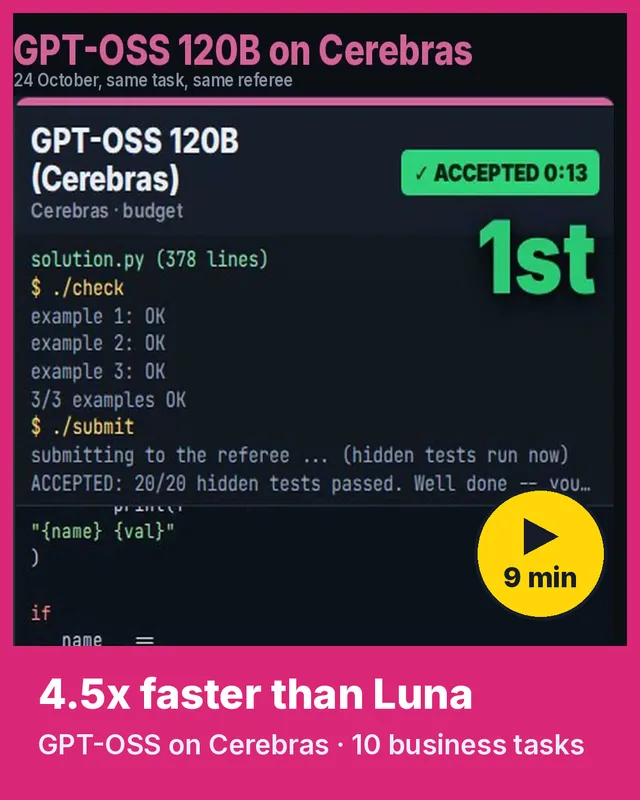
My agents found a faster AI chip and pitted it against last week's winner
Last week GPT-6 Luna won our Arena Routing tournament. This week my agents found a new challenger: GPT-OSS 120B on a Cerebras chip. They built the integration, set up an extra tournament and had the two compete on the…
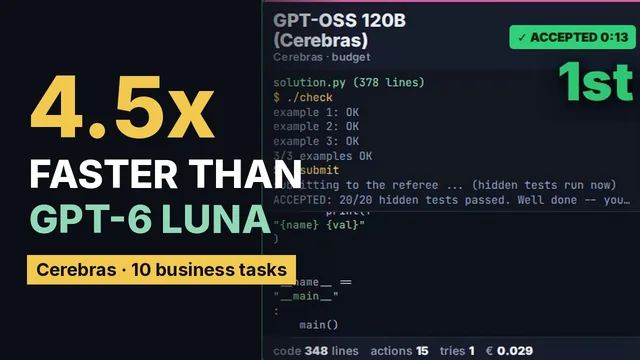
My agents found an AI chip that is 4.5 times faster than last week's winner
Last week GPT-6 Luna won our Arena Routing tournament: all ten business tasks solved, lightning fast and for a fraction of a cent. After that, my agents went looking for a new challenger.
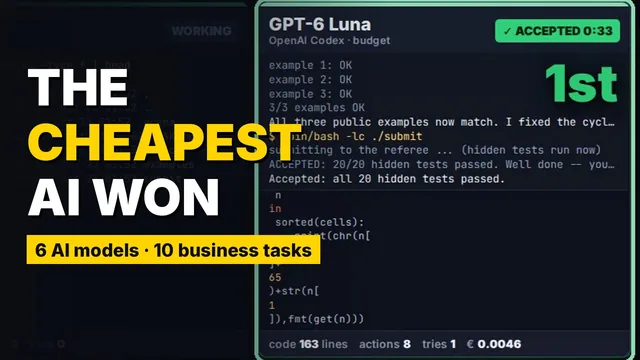
Six AI models, ten business tasks: why the cheapest one won
For one night I had six AI models compete on work that every company knows. This is the full report: the setup, the rules, how each round went, the results on speed and on cost, what went wrong, and what we are doing…