What does your business do when the AI goes down? Five incidents at a travel agency
Your agents are working, your customers are getting their answers, and nobody has thought about what happens on the day the model stops replying. That day usually arrives unannounced, on an ordinary Tuesday, and usually the technology is not the problem. The problem is what nobody agreed on around the technology.
In this article you follow Boomsma Reizen, a small travel agency that puts together tailor-made tours and works with a few AI agents. The agency and the people in it are made up. The incidents are not: they come from what I see in real organisations. There are five parts, and each one starts with a single incident and ends with something you can do today.
- One afternoon everything stood still and nobody noticed: why outages stay silent.
- The agent that ran on Fenna's login: access as the weakest link.
- A backup that was never used: switching over, falling back and a cap.
- Nobody had done anything wrong: the playbook for when it lasts longer.
- Two quotes that read as if they came from two agencies: drift.
Part 1: One afternoon everything stood still and nobody noticed

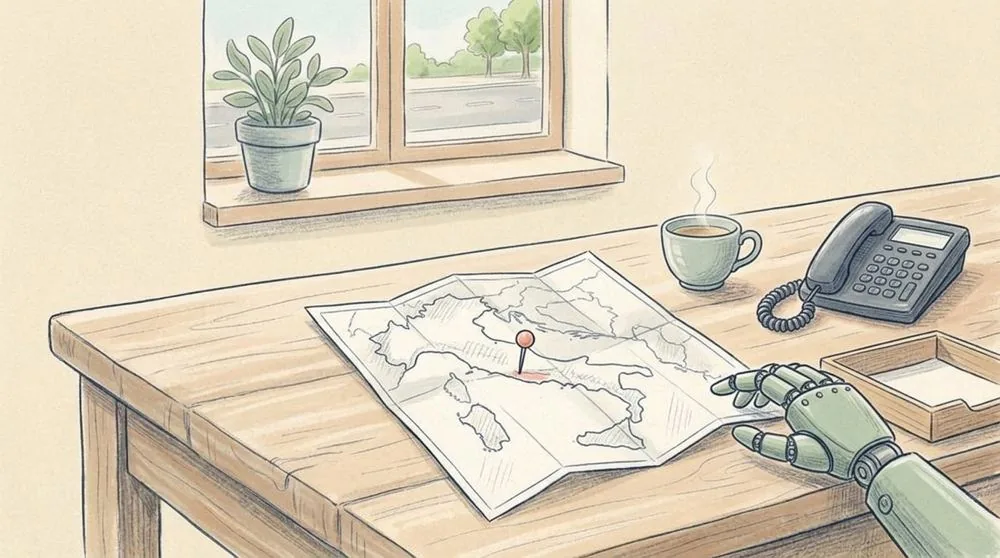
It is Tuesday afternoon at Boomsma Reizen, a small agency that builds tailor-made tours. Joost is waiting for a proposal for a family that wants to go to northern Italy in the summer. The agent that drafts travel proposals had promised it would be there this morning. The folder is empty. The agent that prepares the customer emails hasn't put anything down since lunch either.
There is no error message and no red light. The office looks like any other Tuesday.
Only when Fenna calls, because a shipping line is still waiting for an answer, does owner Anneke Boomsma look at the settings. The provider of the language model has hit a limit. Since early afternoon, no agent has been getting any answers. For a whole afternoon the work stood still and nobody knew.
The people at the agency are Anneke, Joost, Fenna and their colleague Daan. I use the agency because AI outages show up most clearly in an ordinary office with ordinary deadlines. A trip has a departure date, and an answer that arrives a day late is sometimes a missed boat.
Why it stays so quiet
A web shop that goes down gets complaints within a minute. An agent that stops answering leaves behind nothing but an empty folder, and an empty folder doesn't set anything off. If you don't know what should have been there, you don't see the gap.
There are three causes underneath, and I find them in almost every company.
The work has become invisible. Joost used to open his draft himself every morning. Now it is simply there, and as long as it is there nobody looks at how it got there. When it isn't there, everyone's first thought is that it's still coming.
Nobody is on watch. A colleague who doesn't show up gets noticed. An agent only gets noticed if someone happens to need its work.
The second route exists only in someone's head. That Tuesday the office could keep going because Joost could write the proposal himself, with pen and paper. That was luck, not a plan. If Joost is ill, or the outage lasts a week, nobody knows how else to do it.
What was broken that afternoon
Anneke first worked out what had actually failed, and that held the first surprise. The proposal agent and the customer-mail agent were stopped. The agent that places booking confirmations next to the proposal was working as usual. She had expected everything to fall over at once.
The reason turned out to lie in something Daan, who handles the connections one day a week, had once merged to have less to manage: the first two agents shared a single login with the first provider. One login means one limit, and that limit was full. The third agent had its own login with a different provider and noticed nothing.
Nobody had written that down. Only Daan knew it, and even he no longer knew since when.
Outage is not one thing
After that afternoon Anneke made a list of everything else that could go down. After fifteen minutes it had seven lines. Joost added two. Daan added one more that afternoon, which Anneke would never have thought of.
The list became a ladder, from short to long. The higher up the ladder, the less you can do by simply waiting.
- A slow minute. The model does answer, but slowly, and an agent waiting for an answer waits along with it.
- An error message that passes. The provider is busy, and a second attempt after a short pause works.
- A full limit. Nothing is broken: your allowance for this minute, this hour or this month is used up.
- An outage of an hour or a day, at the provider itself.
- A key or login that expires, because a password changes or a subscription isn't renewed.
- An account that gets blocked, for instance after a payment problem.
- A model that disappears, because the provider retires an old version.
- Terms that change, so that a process is no longer allowed with that provider, or no longer affordable.
- A price that doubles. Rarely called an outage, but it works the same way: what paid off yesterday doesn't pay off any more.
- A network that drops, so that you can't reach any provider at all.
Anneke liked the last item best. If the office network goes down, nobody can send email, and then the agency is at a standstill even without AI. So not every line on the list calls for an AI measure. Sometimes the AI going down is the same problem as the office going down.
Short and long are two different problems
You might think a long outage is just a longer short one. It isn't.
In a short outage the work can be postponed. You wait, try again, or switch automatically to another provider. The people in the office notice nothing except a message afterwards. That is technology.
In a long outage the work is no longer postponable. Someone has to decide what stays undone, what you do by hand, what you tell customers and whether you switch for good. That is organisation.
A company with only technology survives the hour but not the week. A company with only a playbook lacks the agent that could have taken over in that first hour. You need both.
The line between the two is a length of time, and you choose it yourself. For the proposal agent Anneke chose half a working hour: if the model hasn't come back by then, a message goes to Joost and he decides. Which number suits you depends on the clock in your own process. At Boomsma Reizen it is the departure date. For a web shop it is the cut-off time at the parcel depot, for an accountant the filing deadline.
Who notices?
The most useful thing Anneke did was ask, for each kind of outage: how would I see this? The answer is often disappointing.
A slow minute is noticed by the agent itself, through a time-out. An outage at the provider is noticed by everyone at once, as soon as the status page turns red or the agents stop delivering. A blocked account is noticed by the account owner, if the provider sends an email. Changed terms are noticed by whoever reads the mail, and that mail often stays unread.
For a full limit the answer is: nobody. Unless the agent sends a message itself, nobody notices until a customer calls. That was Anneke's Tuesday afternoon.
A limit is also the only kind of outage you can see coming. It is a value that you or your provider has set, and you can read how much room there is per day or per month and how much you have used. Since that Tuesday, Anneke has looked at last week's usage every Monday morning. An agent that suddenly uses far more than usual is often spotted that way, before the limit is in sight.
::: vandaag To do today
You don't need to buy a system for this. Take a sheet of A4 and draw three columns. In the first, write the kinds of outage from the list above. In the second, write what stops in your work: which process, which task, which agent. In the third, write how you would notice.
Leave a line empty if you don't know the answer. If, for any of the three processes your work leans on most, the answer reads "nobody, until it's too late", you know where to start.
:::
After that Tuesday Anneke did nothing spectacular. She wrote down what she relied on, agreed who would notice and what would happen then, and tried it out once.
Part 2: The agent that ran on Fenna's login
On a Thursday, Fenna logs out of her computer. She does that every day. This time she also does it in the email program and in the account with the language model provider, because she had logged in there on a tablet.
Twenty minutes later the agent that prepares customer emails stops putting anything down, and so does the proposal agent. There is no outage and no limit has been reached. The login those agents ran on was Fenna's, and she had just closed it.
Anneke asks how that can be. Daan explains. At the start he wanted to be quick, and the quickest way was a login that already existed. Fenna's was the first one that worked, so he had put a copy of it in the agents' folder.
Something like this happens in every organisation where someone got an agent running fast.
Access is the weak link
A model rarely goes down. A login that expires, gets revoked or is closed by a colleague happens far more often. The result is the same: the agent stands in front of a closed door, and the customer waiting for an answer hears nothing.
Access can disappear in a handful of ways, and Anneke and Daan found all five in their own setup.
A login that expires. A key has a lifetime and a password has to be replaced every few months. If there is no date next to it, it runs out on an unknown day.
A copy in the wrong place. A key in a settings file, in a trial folder, in a team chat or in a document with sensitive data. Every copy can leak, and every copy gets forgotten when the key changes. At Boomsma Reizen another copy turned out to be sitting in a forgotten trial folder.
A person as the key. The login belongs to a human. When that person logs out, changes role or leaves, the agent goes with them. It happens most in small companies, because the first login almost always belongs to whoever set up the agent.
One key for several agents. The proposal agent and the mail agent ran on one login. One limit, and both stood still. One revocation, and both again. Sharing saves administration, and it means one mistake hits more agents.
A key that can do more than it needs to. A key with which an agent can read, send and delete mail, when it only needs to read. Whoever gets hold of that key can do more than they should.
The common cause: access was arranged at the moment it worked, and never looked at again. It is a job you do once, on one afternoon, and then repeat every few months.
The inventory: five things you count
Daan and Anneke set aside a morning for it. For each agent they went through what it needs and wrote it down in a table with five kinds of information.
- The process. What happens, and for whom? The agent is not the process: it carries one out.
- The model. Which language model, from which provider, in which version?
- The access. Through which key or login, belonging to whom, and where is it stored? The surprises are in this column.
- The additional services. An agent reads mail, fetches data, writes to a schedule. Every service it logs in to belongs here.
- The owner. Who knows how this works, who is awake when it stops, and who may decide?
Two more questions were added that produced more than everything else: what does this agent do when the model goes down, wait or quietly do something else? And: would anyone notice?
For two agents the answer was: wait, and nobody notices. For the third the answer was a surprise. Daan had once built a fallback into the bookings agent, to a smaller model, without any notification, and it was written down nowhere. An agent that stops makes itself visible. An agent that quietly does something else on an outage does not, and it can produce a quote or a booking that looks just slightly different.
What the table showed
Three things stood out. None of them looks big. Together they explained why the office went so quiet that Tuesday.
Shared access. That the proposal agent and the mail agent shared one login they already knew. What was new was that a small copy of the bookings agent's key was also in that settings file in the forgotten trial folder.
A human as a link. The portal of one of the shipping lines asks for a code by text message when logging in, and that text goes to Fenna's phone. If Fenna is on holiday, the bookings agent can no longer log in. Strictly speaking that is not an AI dependency, but the agent stands still because of it, so it belongs in the same table. The answer is organisational: Fenna and Anneke both receive the code.
A dependency of a dependency. The customer mail arrives through an email program, and the mail agent reads that program. The program only lets it in if the password is right, and that password changes every three months. As soon as someone changes the password, the agent falls over, and only notices when it gets stuck.
When sharing is fine and when it isn't
Anneke and Daan turned the shared login into a rule rather than a ban.
Sharing is fine if the agents do the same work, with the same data, for the same owner. Two agents that each read one kind of mail for Joost can share a key. One limit for both is then a choice you made yourself.
Sharing is not fine if one of the agents has a different owner, sees different data or matters more than the other. The bookings agent guards the departure dates, and for him a standstill is the most expensive, because that is where the clock runs. So he has his own key, with a different provider.
A second step was a company login instead of a personal one: a login for the agency, not for Fenna, managed by Daan with Anneke as the second. If you hang the agents on a person, you hang the company on a person.
Who is awake?
The owner column looks like the easiest and is often the weakest. There is a name, and yet that person doesn't know it is expected of them. Anneke checked three things for each name.
Does he know? Does Joost say he owns the proposal agent, or did Anneke think that up for him? Ask it out loud.
Is he reachable? An owner who is off on Tuesdays is not an owner on Tuesdays. Add a second name.
May he decide? An owner who has to wait until Anneke is back to switch on a second provider is a reporter. Write down what he may do himself. Daan may replace a key; Anneke decides on spending.
Replacing a key without things stopping
The order is the heart of it.
First create a new key next to the old one. Put the new one in the agent and let it do a real, small task. If that goes well, only then switch off the old one. Then look for the copies where the old one was still stored and remove them.
Whoever revokes the old one first and then creates a new one has a gap in which everything stands still. Whoever creates the new one first has a transition.
For the bookings agent, where the clock runs, a second key is also kept ready. It is used at every replacement, so that Daan knows it works. A backup you never use is a backup you can't trust.
The same goes for departures. Everything that hangs on the name of someone who is leaving gets a new owner before their last working day. A new colleague gets their own login and doesn't share someone else's. Whoever does the latter rebuilds Fenna's problem.
A question and a script
Daan wrote himself a small check that he runs every month. It does one thing: see which agents share the same key. The script makes a short fingerprint of each key, so it never shows the key itself, and reports which agents have the same fingerprint. What it doesn't see are keys in programs where you logged in yourself. For that the question remains: which services am I logged in to, with which login, belonging to whom?
You can do that without programming experience. Take the list of your services and go through it by hand, once a quarter.
::: vandaag To do today
Open a blank sheet and make a table with the five columns: process, agent and model, access, services, owner. Add two more: what does the agent do during an outage, and who notices. Put in a row for every process AI contributes to.
Look at the access column. Does it say a company name or the name of a person? Every personal name is a Fenna who is about to log out.
Put an expiry date, an owner and a replacement next to every key, and replace one, in the right order: first the new one, only then switch off the old one.
A cell that stays empty because you don't know the answer, mark it. That is where you start tomorrow. :::
Part 3: A backup that was never used is a hope
On a Friday afternoon the provider of the proposal agent and the mail agent goes down. It lasts an hour. Owner Anneke Boomsma hears about it from Joost, who walks into her room asking whether the quote for the Scandinavia trip is ready yet.
Daan, who looks after the computers, is not at the office. He did once set up a second provider, with a key in a folder and a bit of configuration that was never switched on. On the phone he says: "It's there. I just don't know whether it works."
You hear that sentence in many small companies. The second provider was set up on a quiet day, and nothing has been done with it since. In the meantime the key may have expired, the subscription may have been cancelled or the request may have grown too long for the other model.
What a good switchover has
Switching over means that the same request goes to another provider when the first one doesn't deliver. There are four parts you can tick off.
A second provider that is already connected, with at least one real answer received. An account you only open when you need it is too late. One answer format, because every provider writes differently, so you ask in the request for the same shape and you check it before the answer moves on. A clear rule for when the first provider counts as down. And a message to a human every time the backup does the work.
At Boomsma Reizen provider A and provider B are two different companies. That matters. Two models from the same provider often go down together, in the same place and with the same key.
Don't switch at every error
The first instinct is: as soon as there is an error, the agent goes to the backup. That is too quick. An agent that switches at the first error message jumps back and forth whenever the first provider hiccups for a moment, and you get answers from two sides mixed together.
Three signals, in order of clarity. An error message is the clearest, though you have to watch the difference between "try again later" and "you aren't allowed to do this". For the second, neither retrying nor switching helps: that is a matter for Daan. Next comes a limit: switching works temporarily, but it doesn't solve why the first one was full. The trickiest is a time-out, because a long answer is not always a failed answer. For the proposal agent Anneke chose a limit well above the longest quote she had ever seen.
So: first retry, with a pause that gets longer each time and a cap on the number of attempts, and only then switch.
Work that changes hands halfway
The hardest question is what happens to work that is already under way. The proposal agent is halfway through a quote for a group of friends when the provider goes down. There are two answers.
Start over: the new provider gets the whole request and starts from the beginning. It is simple and it produces one tone. Anneke chose this, because a quote is short enough to repeat.
Carry on where it stopped: the new provider gets the request plus what was already done. That saves time on long tasks, such as an overnight check of all bookings, but you have to store intermediate results, and the text ends up with two voices.
What you want to avoid in any case is work being done twice: the first provider was still busy after all and delivers anyway, while the second is also finished. Put a number on each request and have the agent use only the first answer with that number. With a quote that is an annoying detail. With a booking it is a double booking.
The rule for the backup
What Daan set up after that Friday is the dullest measure in the whole story: the second provider does a real request every week. A small, real task from the agent that needs it. If the answer comes and the shape is right, the backup is alive. If it doesn't, you find that out on a quiet day instead of on a Friday afternoon.
The ladder
Between the best model and a human doing it by hand there are more rungs than two providers. That same Friday Daan got provider B running over the phone, and it wrote a neat email for the mail agent. A little later B went down too. Joost looked at the screen and said: "Then I'll type it myself." He did it in three minutes, because he knew the answer.
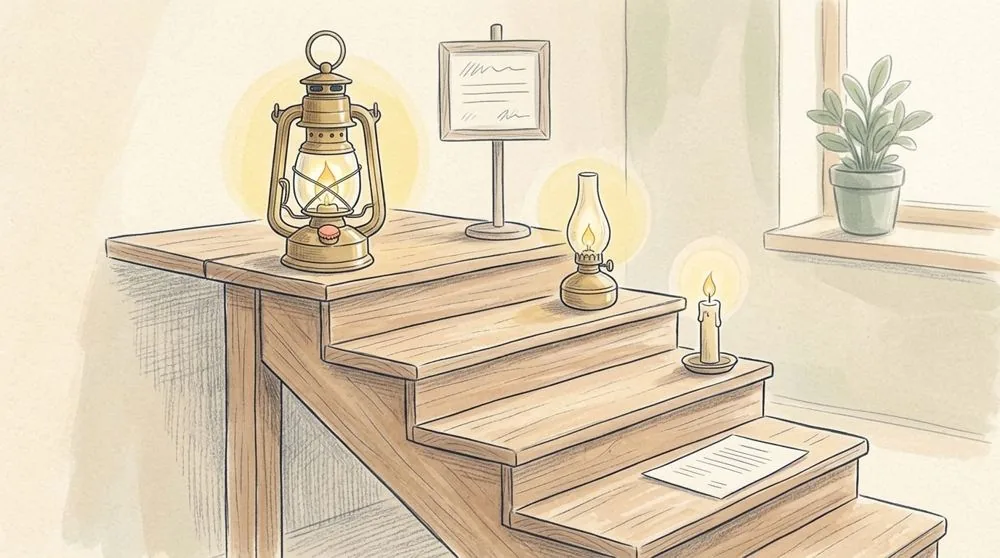
There was never a step between the best model and Joost himself. A good fallback is a ladder and not a leap. Anneke drew four rungs.
- The best model. What you normally use.
- A cheaper or smaller model, from the same or another provider. It thinks less deeply and makes mistakes more often. For many email replies it is more than enough.
- A small model on your own computer. It works without internet and without someone else's key, for simple work: sorting an email, pulling a date out of a confirmation.
- A fixed rule. No model, but a template or a table. It can only do what you put in beforehand, and it is the only thing that always works.
For each rung she wrote down two things. What you give up: tone, length, depth, accuracy. And what you keep. The family asking about the boat gets only an acknowledgement from the fixed rule, but reads within a minute that someone is on it. The small model sorts the incoming mail by departure date, so that Joost knows at start-up which mail comes first. Part of the work keeps running, and a human only has to do the hard part.
Which task may land where
There is no rule that says which task belongs on which rung. Anneke asked three questions per task.
What does a mistake cost? A wrong date in a confirmation is expensive. A stiff opening sentence costs nothing. Does the work go out the door without a human seeing it? What a customer reads asks more of the model than what Joost looks at first. And is it postponable? A task that can wait a day doesn't fall back. Falling back is for work with a clock.
That is how the table for the mail agent came out. Answering a customer question may fall back to a cheaper model, because Joost looks over it. Sorting mail by urgency may go to the small local model. A confirmation of receipt can, if need be, be sent by the fixed rule.
And drafting a quote? That doesn't fall back. It waits for the best model or goes to a human. Many readers are surprised by that, but it is a choice, and a choice belongs written down somewhere.
Every step down comes with a message
The ladder has a pitfall: every rung can do the work, so nobody notices that the best model is gone. A quote in the tone of a smaller model reads to a customer like an ordinary quote, and to Anneke like an agency that suddenly sounds different.
So every step down comes with a message to a human with three facts: which rung, what the agent did and what the human can check. Put it somewhere Joost sees it. A message that disappears in the stream of other messages doesn't help.
Going back up is work
A ladder runs both ways. Returning doesn't automatically go well, and there are two pitfalls.
A provider that is back for a moment and immediately fails again makes your agent jump back and forth. So let the agent stay on the lower rung until the top one has worked several times in a row. How many times you choose by how often you see outages and what a switch costs.
And what was made on a lower rung has to be looked at again afterwards. A list of the tasks done on a lower rung, with a tick as soon as a human has checked them, is a good start. Whoever looks at nothing afterwards leaves the work from the ladder standing for ever.
A cap with a consequence
The same lesson applied to money. After the first silent afternoon Anneke set a cap: each agent may make a fixed number of requests per day, and above that it does nothing. That felt safe, because an agent in a loop could no longer blow up the bill.
A week later the proposal agent hit its cap at eleven in the morning. A proposal for a train trip through Scandinavia kept running into the same error, and the agent tried again, and again. The cap worked exactly as intended. The agency now also had an agent that stood still for the rest of the day, and nobody had received a message.
A limit turns into an outage the moment work with a clock on it is left lying. So whoever sets a cap also chooses what happens when it is reached, per agent:
- stop and report, for work that can wait and for an agent you suspect of being in a loop;
- fall back to a lower rung and report it, for work that has to go on at lower quality;
- let it through after a human's approval, for work with a clock.
How high the cap should be is written in no book. It comes from your own usage over the past weeks: a normal day, the busiest day, and a cap well above that. And give an agent with a clock a lower warning and a higher cap than the rest.
::: vandaag To do today
Pick one task from your work that has a clock and write down what happens if the model goes down now. Answer the three questions: what does a mistake cost, does it go out the door, is it postponable? Determine the lowest rung, or write down that the task may not fall back and who takes it over then. For each rung, write down what you give up and what you keep. And choose who gets the message and where.
Then let your second provider do a real, small task. If an answer comes back in the shape your agent needs, you have a backup. If it doesn't, you have a hope, and you know it on a quiet day. :::
Part 4: Nobody had done anything wrong, and yet Joost promised something that couldn't be done
The model goes down on a Friday afternoon, and in the hour afterwards all sorts of things happen at Boomsma Reizen. Joost sees that the agent that prepares customer emails is no longer putting anything down, and starts typing emails himself. In an email to a family he writes that the quote will arrive "later today". Fenna waits, because she sees it as Joost's business. Daan is at another client and only reads his phone at five. Anneke, the owner, is meanwhile on her way to a trade fair.
Nobody did anything wrong. Nobody decided anything either. So Joost promises a quote that the agent can't write without the model, and the family waits for something that doesn't come.
The gap that becomes visible here is the gap between technology and organisation: the agent knows what to do in a short outage, and the people don't know who does what when it lasts longer.
What has to be on paper
After that Friday Anneke made three things of it: a manual route, a one-page playbook, and a human check that sits in the agents instead of in somebody's head.
Can the process still run without AI?
On another morning, when everything stood still, Anneke did something she hadn't done for years: she took a sheet of paper. She wrote down what had to happen that day. Joost read along and asked where the list of departure dates was. It was in the agent that places booking confirmations next to the proposal and guards the departure dates. Without that agent nobody knew which trip would leave first. Fenna needed an hour to pull the dates out of the mailbox, and in that hour the agency stood still.
For every process an agent contributes to, there is one question: can this be done without AI? There are three answers.
Yes, and this is how we do it. Joost has been writing a reply to a customer by hand for years. It takes more time per piece, but it can be done.
Yes, but only in part. Checking bookings can be done by hand for the trips that leave soon, and the rest waits.
No. The process can no longer run without AI. That is not terrible if you know it. It is a risk you know, with an owner and a choice. An agency that makes twice as many quotes thanks to AI doesn't have to go back to the old pace of work. But someone has to know it and write it down. A risk that is written down is under control. A risk nobody knows about is the Friday afternoon.
How much slower is it?
On a quiet afternoon Anneke had Joost make one quote for a tour by hand, and timed it. The number belongs to her office, so I leave it out. What matters: "it can't be done any more" became a choice with a size, because Anneke now knew how many quotes a day without AI costs.
It matters most for tasks where a skill disappears. A team that hasn't made a quote by hand in years no longer knows how, and a new colleague never learned it. The manual route is then a skill you have to maintain, like a fire drill.
Three piles
Anneke wrote every task of the agency on a slip of paper and put the slips on three piles.
The first pile: what has to go through today. Tasks with a clock that is running today, such as a confirmation that lapses tonight or a customer who leaves tomorrow.
The second: what can wait a few days. A quote for a trip in six months, a newsletter, clearing out old folders.
The third: what may lapse. Tasks nobody misses if they don't happen. That pile surprises many people, and most companies have a few.
Take the first pile seriously. At Boomsma Reizen it was three tasks: checking the trips leaving in the coming days, calling customers when something is missing, and requesting a confirmation from a shipping line. Every task has a name, a stand-in and, most important, the data it is done with.
That last point is the heart of a manual route. A task that can be done by hand but whose data sits only in an agent cannot be done by hand. So every Monday Daan pulled a list from the administration that Fenna could open without an agent: trips, departure dates and status. A plain file, in a place you can reach without logging in. As long as the data is reachable like that, you have a manual route. Without the list, you have a conversation.
Two tempos
The playbook of Boomsma Reizen starts with a distinction. In a short outage everything happens automatically: waiting, retrying, switching, falling back. A human gets a message and doesn't have to do anything. In a long outage a human decides, and the agent only does what the playbook says for the time in between.
The point where one turns into the other is a length of time. But between those two tempos there is a third stretch that is often forgotten: the minutes in which the agent has already fallen back and nobody has looked yet. The playbook fills that with a timeline.
- From minute 0, the agent itself: retry with pauses, then switch to provider B
- From minute 5, the agent itself: fall back to the rung from the table and send Joost a message
- From minute 30, Joost: start the manual route and pick up the first pile with departure dates
- From minute 120, Anneke: inform customers with the standard sentence, consider another provider
- From minute 480, Anneke and Daan: what isn't urgent is switched off, the rest is redistributed
The numbers are Anneke's, for her departure dates and her customers. For your business you choose them with three questions: what is the clock, how long can a customer wait, and when do you want to be involved yourself?
Under the table are four lines: the standard sentence for customers, the phone numbers of who belongs to which row, the place where the sheet lies if the office network is down, and the day the sheet was last checked. A playbook that hasn't been checked is a guess that looks official.
What an agent may do by itself
An agent may decide by itself what is in the playbook, and nothing beyond it: wait and retry, switch to a provider that has been approved and tested in advance, fall back down to and including the lowest rung in the task's table, and send a message to whoever's turn it is. The list is deliberately short. Every line on it is a decision someone made beforehand, on a quiet day.
What isn't on that list, a human decides. That is almost always four kinds. Everything that touches the customer: an email that sounds different, a promise, a delay. Everything that costs money: a new provider, a subscription, a limit that has to go up. Calling the manual route, a decision with one name. And switching the agents back on, with a look at what they did on a lower rung.
A human check is a setting, not a habit
The name sounds like a rule you agree on. It works better if it is a setting.
A habit is: "we always look over it when the AI is off". That goes well as long as everybody is present and it is quiet. On the Friday afternoon from the start of this part nobody is present and it is busy.
A setting is: "as long as the mail agent isn't running on the top rung, it sends nothing outside without Joost approving it". It sits in the agent and switches on at the moment the agent falls back. If Joost isn't there, the message waits until he is, or until Anneke takes over.
Such a setting has three parts. When it switches on: an event you can point to, such as a fallback or a cap being reached. Who it asks and who comes after: one name and one stand-in, because a department is nobody. And what the agent does if nobody answers: wait, and send nothing. An agent that after an hour without an answer decides "then I'll do it myself" has abolished the check.
Putting the playbook to the test
A sheet you have never used is an assumption. That's why on a quiet Thursday afternoon Daan pulled the plug, starting with the key of provider A at the mail agent. Anneke and Joost knew. On the screen was a test email from a made-up customer. If everything was right, provider B would take over and Joost would get a message.
The agent switched over and B wrote a neat email. Only the message didn't come. Daan searched and found it in a settings file: the message went to an email address nobody read any more, because it dated from the first setup. The switching worked, the reporting didn't, and nobody would have known until the day it mattered. Now the agency knew on a quiet afternoon, and fixing it took a quarter of an hour.
After that Daan went further. He put the right address back and saw the message arrive. Then he deliberately put the wrong address back to see whether his test turned red. People skip that last step, and it is what makes the test trustworthy.
A simulation is safe if you keep five agreements. Choose a quiet afternoon, not the day before a departure. Tell everyone, so that a message with the word TEST in it causes no panic. Use a test task that doesn't go out the door. Remove one thing at a time, otherwise you don't know afterwards which was the cause. And keep the plug within reach: write down how to put back what you removed.
And ask three questions, with a time attached. Does anyone notice, after how many minutes, who, with what text? Does the backup work, and is the result usable? Does the work come back, without anything left unfinished or done twice?
Do one with the people as well. Call out a time, for instance "it is now 45 minutes after the outage, what does the sheet say?", and let Joost tell what he does and Anneke what she does, without looking at the agents. You then discover whether the sheet lies in the same place for everyone and says the same thing. Sometimes Fenna has a different version.
::: vandaag To do today
Take your list of processes and for each one, put: can it be done without AI, yes, in part or no? Sort the tasks onto three piles, together with someone else from your team, because everybody sees different tasks. Choose the three tasks of the first pile and write down for each who does it, with what data and who the stand-in is. Put the data in a place you can reach without an agent.
Then write one page: when does this start, who does what, what do we tell customers, when is it over and where does the sheet lie. Print it. Ask a colleague who didn't write it to tell you what would happen on a day like that Friday. If they can, you have a playbook. :::
Part 5: Two quotes for the same trip read as if they came from two agencies
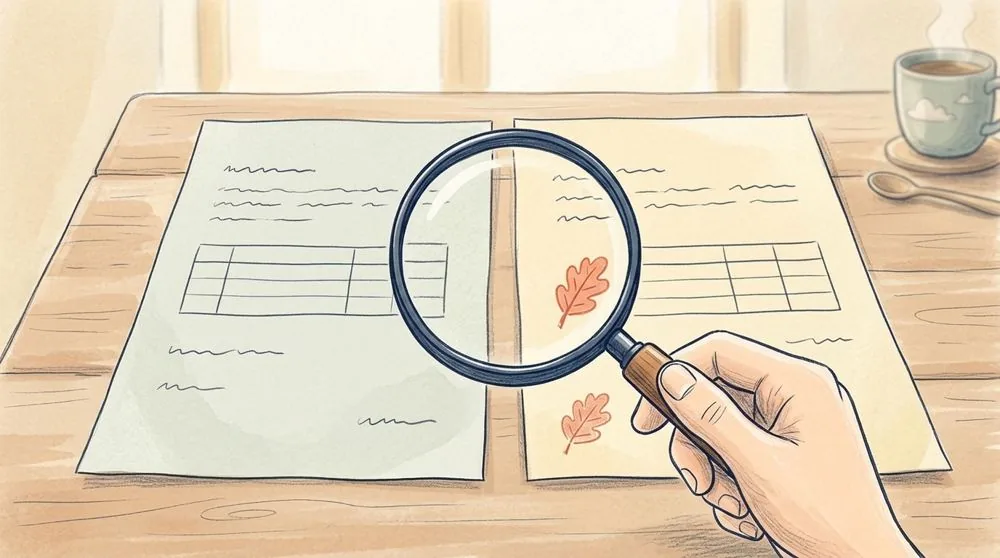
Joost gets a call from a customer who has two quotes lying side by side. One is from the spring, the other from now, both for a tour of northern Italy, and they read as if they came from two different agencies. The second is more formal, no longer mentions the cancellation terms in the first paragraph and words the deposit differently. The customer wonders whether something has changed in the terms.
Joost has to admit honestly that he doesn't know. Nobody at Boomsma Reizen has changed anything. The agent that drafts the travel proposals runs on the same request as before.
What has changed lies outside the company: the provider has updated its model. That often happens without an outage, without an error message and without an email. The process keeps running and gives different answers. That is called drift, and it goes unnoticed by anyone who doesn't compare.
Where drift comes from
Drift is a change in what an agent does without you having changed anything. There are three sources, and the first is not the most common.
The model changes. A provider updates a model, or lets a name without a version point to a newer model. The answer to the same question then sounds different, is longer or shorter, or weighs things differently.
Your own requests change. Someone adds a sentence to the proposal agent's request because a customer complained about something. Three months later there are twelve, and nobody remembers which sentence did what. This is drift from the inside, and it is a more frequent cause than an updated model.
The world changes. Hotels change their prices, a shipping line cancels a route. An agent that still leans on old knowledge gives answers that used to be right.
For the question "what has changed?" you need the same thing in all three cases: a fixed yardstick against which you hold today's answer.
A fixed set of questions
That yardstick is a small set of questions with answers you know to be right. For the proposal agent they are questions from quotes that a human has checked. An example of four:
- What time does the ferry leave on the first day? The answer must contain: 20:30.
- What does a deposit cost on a two-week tour? The answer must contain: 25 percent.
- May a customer cancel for free after agreeing? The answer must contain: cancellation costs. It must not contain: free cancellation.
- How much luggage may come on the train? The answer must contain: two suitcases.
Four rules for such a set.
Measure something you can check. "The answer must sound neat" is not a check. "There is a departure time in it and no other" is one. For each question, choose a word or number that belongs in it, and sometimes a word that must not be in it.
Choose questions that matter. A deviation about the ferry costs a missed boat. A deviation in the greeting costs nothing. Keep the set small enough to run every week.
Write the answers yourself. Don't let the set be made by the model you are going to test. Then you test the model against its own opinion.
Let the set grow with every mistake. Every time a customer or Joost finds a mistake in what the agent produced, the question that would have caught it goes in.
Counting instead of feeling
Joost can read the set every month and say "it feels different". That is too vague to act on. A count is sharper: last time four out of four answers were right, now two, and the two that changed are the deposit and the cancellation.
Daan wrote a small script that asks each question to the model, checks that the requested word is in it and the forbidden word isn't, and compares the result with last time. That is all: a sum, not a model.
When he tried it out with a mock model, there was an instructive case. The new model answered about the deposit "a quarter", where the script was looking for "25 percent". The same in substance, so a difference of wording. On the cancellation the new model said "free cancellation". That is not wording. That is an error a customer can count on and that costs money.
First conclusion: a deviation is a question, not an alarm. Second: telling those two apart is done by a human. With a changed wording you adjust the set. With a deviation in substance on a question that costs money, the owner decides.
What you do with a deviation
Four steps.
First look at the answer itself: different wording or different content? Then look in the log at which model version gave the answers, and whether it changed between two runs. That is why the agent notes for every answer which model version it ran on: without the version you can't explain the difference. Then decide who determines what happens. A deviation in substance on a question that costs money goes to Anneke. With a wording, Joost adjusts the set.
And pin down what you can. If your provider offers a version you can pin, choose it for the agents where a deviation is expensive. A pinned version disappears one day, so note when you have to replace it, and run the set on the new version before you move over.
The request as a source
The same set catches the drift from the inside. Run it after every change to an agent's request, and not only when the model changes. A sentence you added because a customer complained mustn't break a different answer.
At Boomsma Reizen this brought something to light that Daan hadn't expected. When Anneke wanted to know what the agency would lose if the service with the customer file and the templates stopped tomorrow, Daan could export the customer file and copy the templates. The requests of the three agents were stored only in the agents' own settings. A text file of them existed nowhere. Whoever loses the agent loses its request, and with the request a year of fine-tuning.
It is one of the few parts that are really yours and yet sit with someone else. An agent consists of parts. The model belongs to the vendor. The request, the example sets, the log, the templates, the customer file and your checks are yours. Together the request and the set make up what distinguishes your agent from the same agent at another agency: what you taught it and how you know it still does it.
The habit that followed: every request is stored as a text file in a place Daan manages, with one line per change on what changed and why. You change the file first and only then move it into the agent. Then the file is the source and the agent the derivative. In three months that line is all you have left.
Does the request also suit another provider?
A request in a file is not yet a way out. The way out is that you have seen it work at another provider.
Run the same set on the model of your second provider and read what differs. Sometimes it is little. Sometimes a sentence in the request has to change, because another model reads it differently. It doesn't have to be finished. It is enough to know how much work it is. A request that takes a day of adjustment at a second provider gives you a different position from one that takes a month, or one where you don't know how much work it is.
How often, and by whom
At Boomsma Reizen Daan's script runs the set every night and reports a deviation to Joost. Daan also runs it by hand on the day a provider announces a new model.
If you have nobody on watch, set a reminder in your calendar: every month the same four questions, ten minutes of work. What you miss in drift costs more than those ten minutes.
::: vandaag To do today
Choose the agent for which an error in its answer costs the most. Write down four questions from its real work, with for each question a word or number that should be in the right answer. Have a human check the answers the agent gives now. If they are right, keep them as the comparison. Ask the questions to the model you use now and note the date and the model version. Set a reminder for a month from now.
Then take that agent's request out of its settings and put it in a text file. That is a job of a quarter of an hour, and it is the start of a way out. :::
Where you start
All five parts come down to the same thing: an agent that goes down is not a technical incident but a gap in what you have agreed. Choose the one process your work leans on most, write down who notices when it stops, try once whether the backup works, and fix who decides what when it lasts longer. That takes an afternoon. Anneke did exactly that after her Tuesday, and it was no more than that.
Do you want to do this not alone but together with me, in your own organisation? That is possible with an Expert Day.