I share my knowledge and experience with AI agents. You keep control.
Many companies ask me the same thing: could you build this for us as well? My answer is almost always: I would rather help you do it yourself.
There is a reason. A company that wants to work with AI agents builds something that ends up in its daily work. It touches its customers, its administration and its people. Whoever outsources that is afterwards dependent on someone else for every change. Whoever understands it can adjust it when the company changes.
In this piece I explain what I do because of that, and what you can expect from a day with me.
Where my knowledge comes from
I have worked as a software engineer for years, and for some time I have been building an organisation of AI agents that really runs. There is a team that works every day: an agent that manages my mail and messages, one that builds the software and one that watches the server. They have a role card, their own tray of work and a log. A human sits at fixed points: what touches money, contracts and publication, I decide.
That work has taught me things that are in no manual. A rule in a prompt is not a wall. A limit that you do not put in the system itself does not hold. You only trust a check once you have seen it go red. An agent that says something is done has made a claim, not provided proof. And the most expensive mistake is often not in the model, but in the old value that was still standing somewhere.
That experience is in my books as well: From Zero to AI Agents That Do The Work is the practical book, The Autonomous AI Company describes what happens when you let this run largely autonomously, with risk control and cost control included.
My offer is a day with you
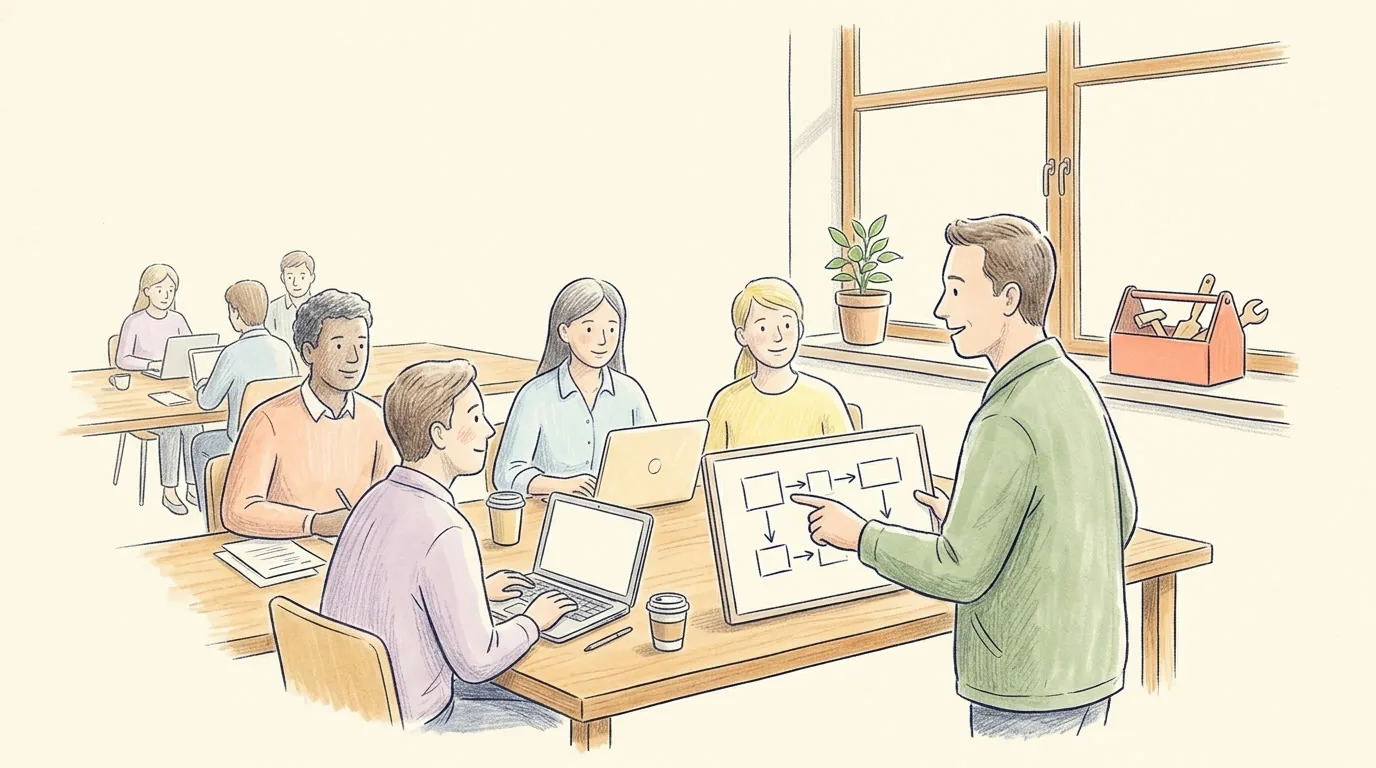
I come to you for a day, on the work floor, and share my knowledge and experience. You organise the day yourself, and I take part with everything I can bring: looking at a process, setting up a first agent and defining the limits.
There is a choice behind that. Because I built the whole chain myself, from the language and the compiler to the development environment and the agents that run on it, I know exactly why something works or does not. That lets me leave the choice of what suits you to you.
What you are left with after a day
The goal is that you can carry on yourself. Concretely:
- A chosen process. A piece of work where an agent can do something, and a piece where a human keeps the last step. From then on you know why.
- Limits that are part of the process. Not in an agreement or a prompt, but in the way the work runs. An agent that cannot pay cannot pay by accident either.
- A first working step. Small enough to check, big enough to learn from.
- A way to review it. What do you check, how do you see that a check works, who gets a message when it goes wrong.
- Control in your own hands. Your systems, your knowledge and your server remain yours. Afterwards you carry on yourself.
The last point matters most: after that one day you know more than before and you are at the wheel yourself.
Why I do it this way
I believe organisations should keep their own control over how they work. Agents change fast. Models, tools and providers come and go. Whoever builds their knowledge can move with those changes. With your own knowledge you keep making the choices yourself.
That is why I also write books and articles, make videos in which you watch an agent at work, and show what goes wrong when something goes wrong. Everything I share here is meant to make the step to doing it yourself smaller. A day with me is the same idea, but at your table.
What I always start with: one process, one limit
Whether it is a company of ten people or of a thousand: it starts small. Pick one process and decide beforehand what the agent may and may not do there. Not after the first mistake, but before the first step.
Three questions help with that, and you can answer them today:
- What may the agent never do by itself? Pay, make a promise to a customer, delete something for good. Put that in the process, not only in the instruction.
- Who decides at the point where the agent stops? A name, not a department. And what does that person see at that moment?
- What does a run cost, and what is enough? An agent without a ceiling has no sense of thrift. A fixed amount per day works better than an agreement.
Whoever answers those three has more than most plans I see, and can start tomorrow with a first small step that you can calmly review. A day is meant to sharpen them together, for the work you actually do.
An example from my own team: every lane of agents has a fixed amount per day. Once it is reached, no new turn starts, and the next day it simply carries on. Nobody has to watch, and an agent that gets into a loop costs at most one fixed sum for a day. You do not invent a rule like that in the middle of an incident. You put it in place before your agent starts working, and that is exactly the kind of thing we settle together on such a day.
Who is it for?
For organisations that already notice AI agents can change their work, and that want to stay in charge themselves. A small or medium-sized company with a department that does many fixed actions. A team that has started with agents and gets stuck on control or cost. A board that wants to understand what is possible before putting money in.
You do not need to be able to program, and you do not need to prepare anything except the will to look closely at the work. There does have to be someone who knows the work, because I cannot bring that along.
A first step that costs nothing
Want to look first yourself? Pick one process where your people do the same thing every week. Write down what comes in, what goes out and at which point someone has to decide. That sheet is half of what we would do on the day, and you made it without me.
Want to do it together, on your work floor? That is possible with an Expert Day.