A book for my father: Bijpraten over AI

I wrote a book for my father, and for people his age. To explain what AI actually is: not the headline, but what it is. It is called Bijpraten over AI (Catching Up on AI).
How I set it up:
- Every chapter starts with something from daily life and compares the new thing with something you already know: the encyclopedia, the telephone operator, the librarian.
- It says honestly where the comparison stops.
- Everything is in large print, with cards that summarise each chapter.
- It contains clear rules against fraud. A fraudster can now imitate a voice with AI, like that of a grandson. You do not have to recognise that voice as fake. A few fixed rules are enough: haste is the alarm signal, hang up and call back yourself, never money at the door, always tell someone, and agree on a code word.
About those rules the book has a sentence I like best myself: "The rule thinks for you." A rule exists precisely for the moment when you are upset and your head is not clear.
The book is for sale at bol.com. The paperback can also be ordered in any bookshop in the coming days.
Are you the grandson or granddaughter yourself? Maybe an idea to talk about it together.
Which question about AI do you hear most often from your parents or grandparents?
See also
A chat window answers, an agent does the work
Many people now use AI every day. They ask a question, get an answer, copy it, paste it somewhere else and do the rest themselves. That is useful. It is also something different from an agent.
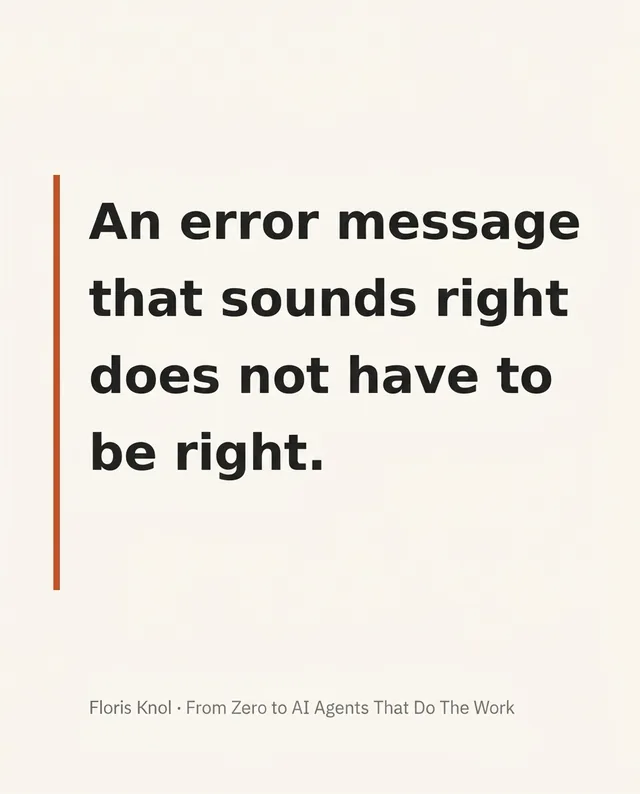
An error message that sounds right does not have to be right
I work with AI agents: programs that carry out a job on their own and use tools while doing it, just like you use a calculator or a search engine. When a tool does something wrong, it gives an error message. The agent…
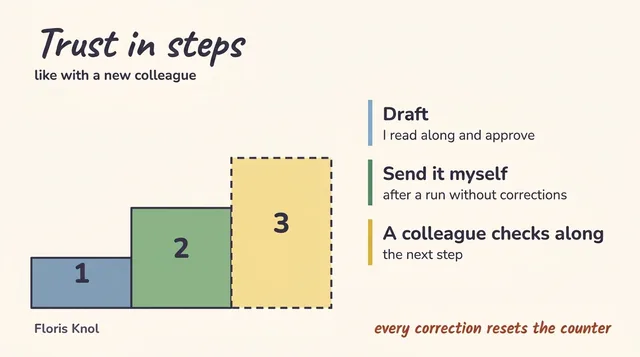
How much trust do you give an AI agent on day one?
How much trust do you give an AI agent on day one?