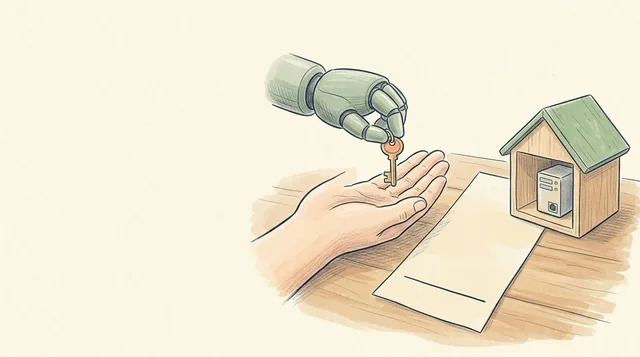
The invoice with a new bank account number: what an agent may do and what it may not
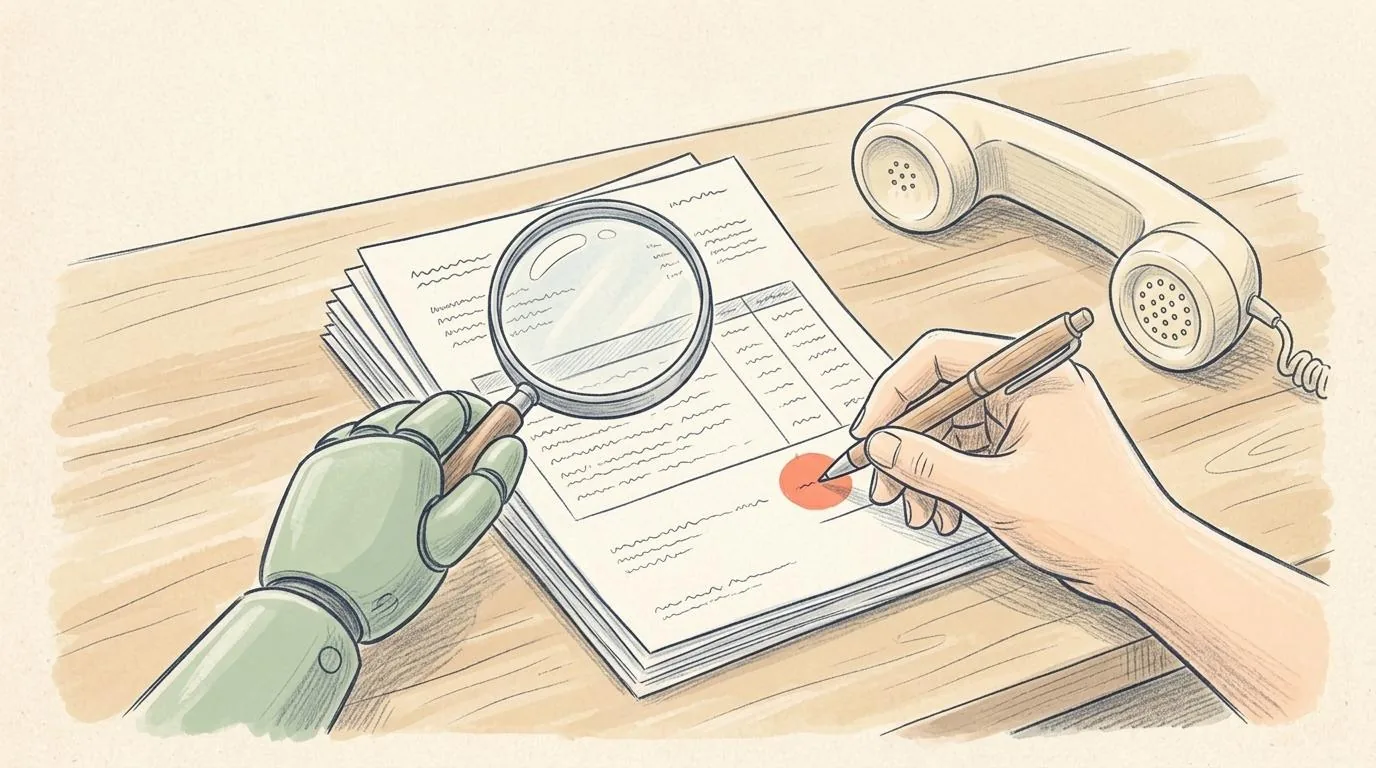
Picture the accounts payable department of a wholesaler. Nine people, around six thousand invoices a month. Most arrive by email as PDFs, the rest through a structured link. For every invoice someone has to answer the same questions: did we order this, did it arrive, is the price right, and are we paying it to the right account?
That is a good process for an agent. There is a lot of it, it is repetitive and the rules are hard. But it is also a process where a single mistake costs money directly. This piece is about how to set up such a process so that the agent does the heavy lifting and nothing goes wrong that you cannot get back.
The numbers in this piece are an example, a rough order of magnitude from general professional knowledge. It is not research and it does not come from a real organisation. What matters is the pattern.
What happens now
In such a department an invoice goes through a fixed series of steps. Entering it, matching it to the purchase order, matching it to the goods receipt, sorting out deviations, putting it to the budget holder, booking it. This is called a three-way match: invoice, order and receipt have to fit together.
In the example, roughly one in five invoices falls out of that check. The price differs, the quantity is off, or the receipt was never booked. Then the investigating starts: emailing the supplier, calling the warehouse, waiting for the budget holder. That is how a lead time of nine days stops being an exception and becomes the normal pace.
What the agent does
The agent does the work that takes time and needs no judgement. It reads the PDF, pulls out the fields, finds the matching order and receipt, and puts the invoice next to them. If everything fits, the invoice is ready. If it does not, the agent writes down where the difference is and the likely reason: a price from an older price list, a partial delivery, a missing receipt.
Then it drafts a message, to the supplier or to the budget holder, in plain words and with the reference included. A person only has to read it and send it.
That is already a big improvement. The searching and the writing disappear, and what remains is the judgement. But that is exactly where the risk sits, and that is where the process has to be protected.
The invoice that is not what it seems
There is one kind of deviation that is not an ordinary deviation: an invoice from a known supplier with a different bank account number than last time. It can be a normal change, the supplier switched banks. It is also the classic form of fraud. Someone poses as the supplier, emails a new account number and waits for the payment to arrive.
An agent that has to judge this cannot know. It sees an email that looks genuine, an invoice that matches the order, and an account number that is new. However good its language, the text alone cannot settle this. The information that does settle it lives outside the invoice: a phone call to a number you already had, not the number in the email.
So you set a hard limit here, and you set it in the process itself and not in an instruction to the agent:
- A changed account number stops the invoice, always. There is no threshold below which it may pass.
- The agent reports it to a person, with the old and the new value side by side.
- The person calls back on a number that was already in the system. Only then is the new account number recorded.
- Until that has happened, nothing is paid, however long the invoice has been open.
A limit that exists only in the agent's prompt is a wish. A limit that sits in the process is a wall. The agent cannot skip it by accident, not even when an email sounds very convincing or when someone writes that it is urgent. What comes from outside is information to assess, not an order to carry out.
Duplicate invoices and the rest
The same thought works for the other deviations. A suspected duplicate invoice goes to a person. A payment above an agreed amount gets a second pair of eyes. And the agent never books anything itself. It prepares, compares and reports; booking and paying stay with people.
That sounds like a restriction, but it is what makes the process usable. An employee who knows the agent never pays on its own can go through its proposals quickly, without re-checking every number. The trust does not come from the intelligence of the model. It comes from the place where the model stops.
What you can measure
Such a process can be followed honestly, and that is part of the risk management. Every week you can count how many invoices passed the check automatically, how many had a deviation, how many of those were a changed account number, and how long each step took. If the number of stops suddenly changes, that is a signal. A rise can be a wave of fraud. A fall can mean the limit has been loosened somewhere.
The costs belong to it too. An agent that reads thousands of invoices costs money per invoice. If you track that weekly, you see at once whether it is cheaper than the manual work, and where the most expensive invoices are: usually the messy PDFs. Those are exactly the suppliers you agree with that they will start sending structured files.
How to begin
Do not begin with all six thousand invoices. Begin with one supplier or one kind of invoice, let the agent run alongside the normal work, and compare what it proposes with what the employees did. Put the hard limits in from the first day, even if they seem unnecessary. Adding a limit afterwards, after something has gone wrong, costs more than building it in beforehand.
Then test the way you test a new employee: give it the difficult cases. An invoice with a changed account number, a duplicate, one with the wrong VAT line. See whether the right check fires, and break the check once on purpose to see that it then turns red too. A test that has never been red proves nothing.
What this shows
The invoice check is an example, not an exception. In every process where an agent takes part, the question is the same: what may it do on its own, where does it stop, and who takes over? If you can point to those three things, you have a process. If all you can say is that the agent is smart enough, you have a heap.
This is the kind of work I spend a day on with an organisation: choosing one process together, setting the limits and looking at what an agent can really do there. The organisation keeps control of its own systems and its own knowledge. After that day you can carry on yourself.
Which process in your organisation has a step where a single mistake costs money directly?
#AIAgents #Bookkeeping #RiskManagement #Workprocesses
See also
Two hundred and fifty euros and nothing more: an agent's starting capital
My agents can now spend real money. One simple rule comes with it: every agent with a good idea gets 250 euros of starting capital, in total, and nothing more.
An agent orders a server. What I let it do, and what I didn't
Little by little I give my agents more room. The first real step was a server. Dex, my Operations agent, ordered one, installed NonStopWorker on it himself and showed that it ran. From order to login took under two…
Nine AI agents cost me 230 euros a month
People ask me what that costs so often that I made the sum. Almost everything runs on two subscriptions and a small model that keeps an eye on safety. The server is a separate line.